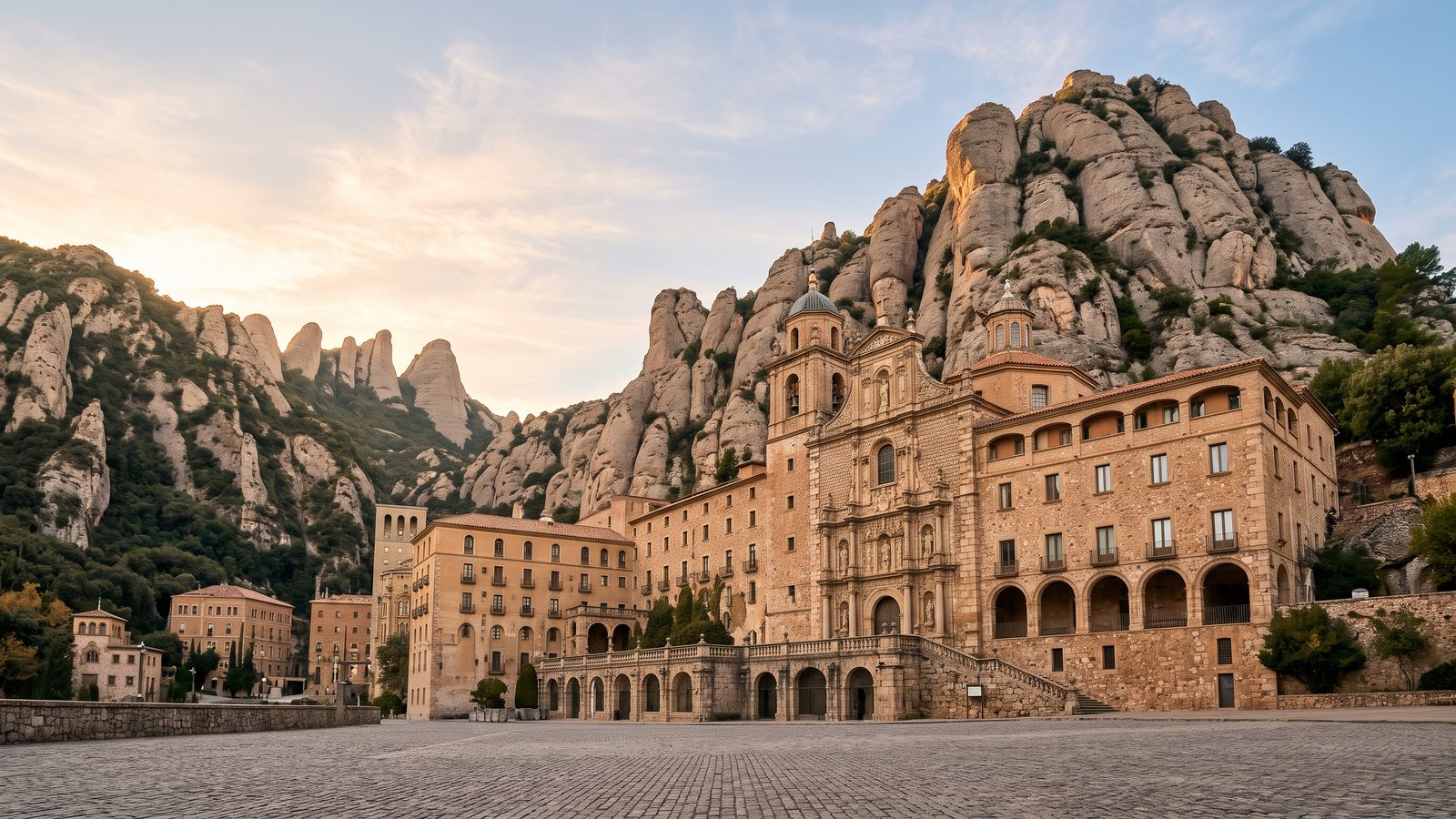
Perched among Catalonia's dramatic, saw-toothed rock formations, Montserrat Monastery has stood as a sanctuary of faith and culture for over a thousand years. On this self-guided audio tour, you will discover a place where nature and architecture blend seamlessly. From its 9th-century miraculous origins to its resilience through modern conflicts, Montserrat remains a powerful symbol of Catalan identity, housing priceless art treasures and ancient Benedictine traditions.
As you explore the monastery grounds and take in sweeping valley views, you will connect with centuries of history. Listen to the story of the sacred Black Madonna, marvel at the unique conglomerate peaks, and experience a living sanctuary where monks still practice prayer and scholarship amid Spain's most iconic mountain landscape.
Listen to a sample
The opening of this tour, exactly as AllTours narrates it on site.
What you'll hear on this tour
Stop 1. The Miracle of La Moreneta
You step into a story rooted in the late 9th century, when shepherd children saw a mysterious light and heard celestial music leading to an ancient wooden statue of the Virgin Mary in a cave. When local authorities tried moving the statue, it became impossibly heavy, signaling her wish to remain on these mountains. In 1025, the Benedictine order established an abbey here, growing from a humble hermitage into a legendary sanctuary. Over centuries, Montserrat weathered severe trials, including the Spanish Civil War, when brave locals risked everything to hide its artistic and historical treasures. As you walk these sacred grounds, you experience centuries of unwavering faith, survival, and profound spiritual resilience.
Stop 2. Living Heritage and Catalan Soul
You stand in a vibrant sanctuary where spiritual tradition meets profound artistic legacy. Listen closely, and you might hear the angelic voices of the Escolania, one of Europe's oldest boys' choirs, echoing through the basilica. Beyond music, Montserrat served as a crucial guardian of Catalan identity and language during political oppression, using its secret printing press to preserve forbidden literature. In the museum, you encounter works by Catalan masters such as Dalí and Picasso alongside ancient religious art. As pilgrims approach the iconic Black Madonna, watch them touch the golden orb she holds—a personal, ancient gesture connecting visitors directly to centuries of shared devotion, hope, and Catalan heritage.
Stop 3. A Thousand Years of Faith
You stand before an edifice representing over a thousand years of continuous Benedictine presence. Look around at the architecture, a striking tapestry of Romanesque foundations, Gothic arches, and Renaissance flourishes. These walls hold memories of destruction and rebirth; in 1811, Napoleonic troops nearly leveled the site, but dedicated monks painstakingly rebuilt every arch stone by stone. As you enter the quiet cloister designed for solitary contemplation, you walk the same paths where generations of monks have dedicated their lives to prayer and scholarship. Observe the detailed carvings framing the entrance, reminding you that this historic monastery remains an active sanctuary where the ancient rhythm of work and prayer endures daily.
Stop 4. Panoramic Views Over Catalonia
As you look out across the landscape, your eyes follow the ancient Llobregat River carving a winding ribbon through Catalonia's fertile plains. Below you, a vast tapestry of green and brown fields stretches outward, punctuated by tiny villages scattered across the valley like small pebbles. On exceptionally clear days, you can even catch the distant, silvery shimmer of the Mediterranean Sea along the horizon. Turning back toward the mountain itself, you come face-to-face with the immense "sawtooth" rock formations, their sheer drops and eroded textures sculpted by millions of years. Standing at this elevation, you feel small yet deeply connected to a natural view that has inspired visitors for generations.
Stop 5. Wild Life Among the Sawteeth
Look closely at the jagged peaks framing the sanctuary and observe a remarkable geological marvel. You are touching ancient conglomerate rock formed millions of years ago as compressed pebbles and sand were gradually sculpted into saw-toothed profiles by wind and water. Notice how resilient Mediterranean plants like holm oaks and boxwood cling to seemingly barren rock crevices, anchoring themselves against the elements. If you glance toward the sky, you might spot a peregrine falcon soaring effortlessly on thermal currents above the cliffs. Take a deep breath of the mountain air, scented with wild pine and herbs—a natural incense that has infused this high-altitude haven for uncounted centuries.
Stop 6. Sacred Needles and Stone Guardians
Cast your eyes upward into the rugged core of Montserrat, where colossal rock needles and natural "organ pipes" rise dramatically into the sky. Formed over millions of years as ancient rivers deposited sediment that was later uplifted and eroded, these sheer conglomerate stone cliffs give the "serrated mountain" its iconic shape. For centuries, spiritual seekers and hermits found solace inside the hidden caves and high mountain ledges scattered across these heights. Today, these imposing stone pillars challenge rock climbers while forming a natural cathedral that predates all human construction. As you gaze up at these silent guardians, you sense the timeless energy of a mountain sacred long before the sanctuary existed.
Planning your visit
- Best time to go
- Early morning on clear days to avoid peak crowds and catch soft morning light on the peaks.
- Approximate duration
- About 2 to 3 hours
- Where to start
- Outside the main Basilica entrance in the central monastery plaza.
Access and conditions change seasonally — check the official site before you go.
Frequently asked questions
Is Montserrat Monastery worth visiting?
Yes, Montserrat Monastery is one of Catalonia's most iconic destinations, offering a unique blend of 10th-century Benedictine history, magnificent mountain vistas, art by masters like Dalí and Picasso, and the venerated Black Madonna statue.
How long do you need at Montserrat Monastery?
Most visitors spend between 2 to 4 hours exploring the main basilica, seeing the Black Madonna, visiting the museum, and enjoying the mountain views.
What is the history of the Black Madonna at Montserrat?
According to legend, shepherd children discovered the wooden statue of the Virgin Mary in a mountain cave in the late 9th century. When local authorities tried to move it, it grew too heavy, leading to the creation of the hermitage that evolved into the abbey in 1025.
Keep exploring
Header image is an AI-generated illustration of Montserrat Monastery. AllTours.ai is an AI audio tour guide — point your camera at any landmark and hear its story.