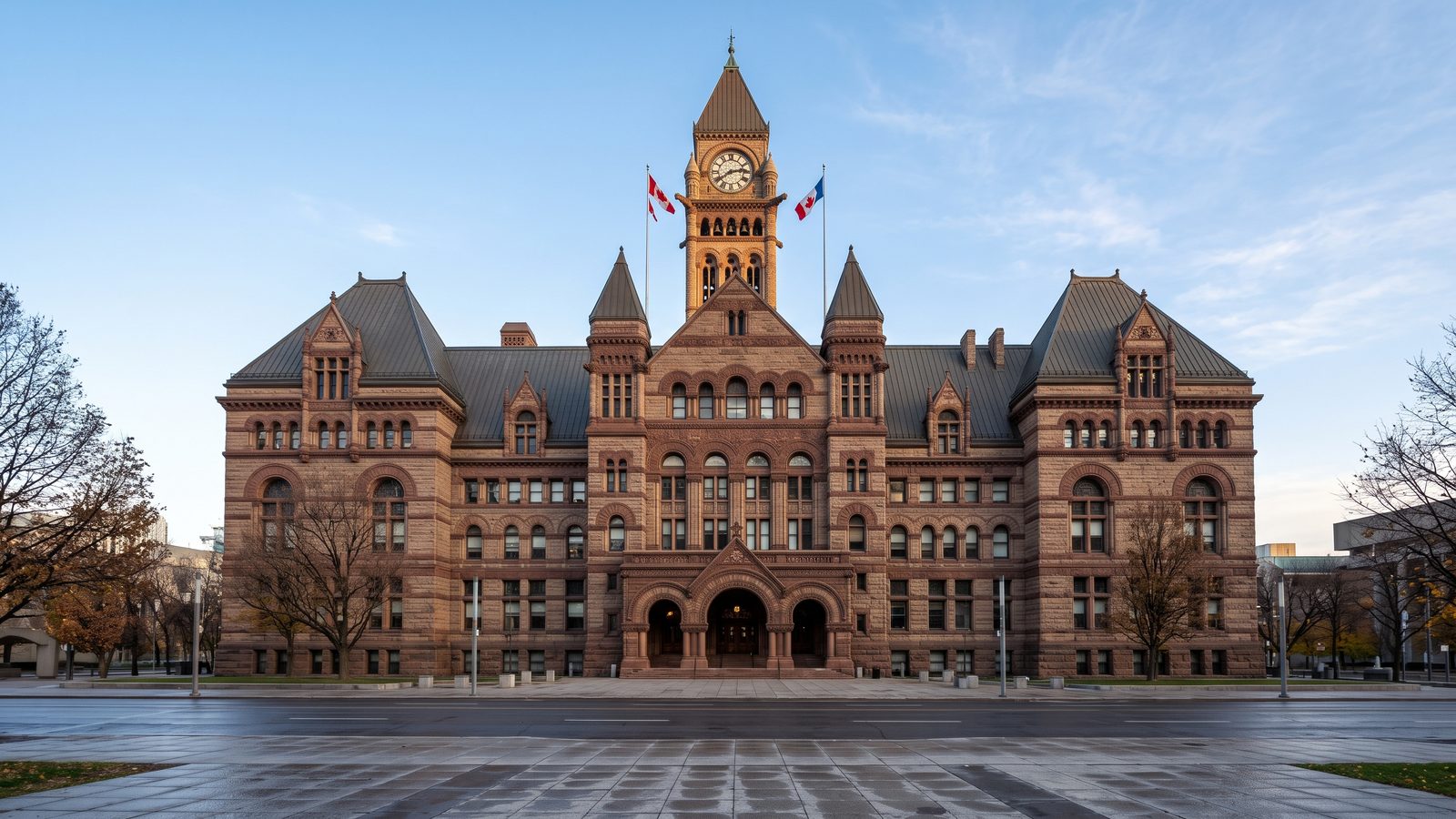
Welcome to Old City Hall, one of Toronto's most striking architectural treasures. Constructed between 1889 and 1899 under the direction of architect E.J. Lennox, this Romanesque Revival masterpiece served as the city's municipal heart for over seven decades. As you stand along Queen Street, admire its monumental 103.6-meter clock tower and robust brown sandstone exterior, which today houses the Ontario Superior Court of Justice while preserving its vital civic legacy.
On this self-guided audio tour, you will explore the captivating craftsmanship, storied political history, and hidden artistic flourishes that define this iconic landmark. From resonant clock chimes to intricately carved masonry, discover how this landmark shaped modern Toronto and survived threats of mid-century demolition.
Listen to a sample
The opening of this tour, exactly as AllTours narrates it on site.
What you'll hear on this tour
Stop 1. The Great Clock and Resonant Bells
Look up at the towering heart of Old City Hall, where a magnificent 103.6-meter clock tower rises above Queen Street. Installed in 1900, this precision timepiece was crafted by England’s famous Gillett & Johnston firm. You are looking at four colossal clock faces, each nearly six meters in diameter, displaying elegant Roman numerals. Behind these faces sits a complex Victorian weight-driven mechanism that once set the daily rhythm for the entire city. Listen closely as you admire the structure; inside hangs 'Great Harry,' a massive 5,300-kilogram bell that strikes the hour alongside two smaller quarter bells, echoing a timeless beat across downtown Toronto.
Stop 2. Richardsonian Romanesque Stonework and Arches
You now stand before a stunning example of Richardsonian Romanesque design, defined by its formidable stonework and monumental arches. Notice the rich textures of the Credit Valley sandstone, quarried near Inglewood, shifting from smooth ashlar to rough rustication across different levels. As you approach the main entrance, observe the deeply recessed archways framed by stout columns with intricately carved capitals featuring Canadian flora and fauna. Above the central arch, the tympanum relief illustrates allegorical figures representing civic justice and governance. Look higher to see corbel tables and delicate terra cotta detailing that balance the building's massive, imposing presence.
Stop 3. Hidden Grotesques and Fine Craftsmanship
As you begin to explore the finer exterior details, keep your eyes open for unexpected secrets hidden within the masonry. Look up beneath the cornices to spot whimsical carved gargoyles and grotesques that double as functional drainage spouts while adding a medieval flair. Walk around the building to see how the sandstone transitions from rough-hewn rock at the base to smooth blocks higher up. At the main entrance, inspect the massive bronze doors, which display detailed relief panels portraying early Toronto history. Even the surrounding ironwork features Canadian motifs like maple leaves and beavers, showing extraordinary artistic care in every detail.
Stop 4. A Decade of Controversy and Civic Pride
Step back into the late 19th century, when a rapidly growing Toronto desperately needed a new municipal center. You are standing on ground once attached to Osgoode Hall, chosen after intense political debate to project the city's rising ambition. Construction lasted over ten years, plagued by staggering cost overruns that fiercely divided public opinion between critics of extravagance and champions of civic pride. Within these walls, leaders spent decades debating pivotal decisions that shaped modern Toronto, from streetcar networks to public health responses. When mid-century plans threatened this landmark with demolition, passionate citizens fought tirelessly and saved it for future generations.
Stop 5. E.J. Lennox and Monumental Asymmetry
Observe how architect E.J. Lennox creates a commanding civic presence through bold massing and textured stone. The warm Credit Valley brown sandstone grounds the building, giving it an earthy weight that projects authority. Notice the deeply recessed doors and windows, designed to create dramatic shadows that enhance the facade's three-dimensional depth. Lennox breaks up the horizontal building line with a varied roofline of steep gables, turrets, and an intentionally offset clock tower. This deliberate asymmetrical composition rejects rigid classicism in favor of picturesque, monumental character, animated by playful carvings and subtle grotesques tucked under the upper cornices.
Stop 6. The Living Pulse of Downtown Toronto
Take in the surrounding downtown neighborhood, where Toronto evolved from a modest trading post into a thriving metropolis. As you look around, notice how historic Victorian brickwork and early 20th-century financial towers blend seamlessly into the modern streetscape. This district served as the commercial hub where fortunes were made, carrying the legacy of early industry and innovation. Subtle Art Deco touches on nearby structures highlight periods of bold progress and artistic confidence throughout the city's history. Here at Queen Street, you are standing in a living archive where every stone reflects the collective memory and ongoing energy of urban development.
Planning your visit
- Best time to go
- Morning or early afternoon for optimal sunlight on the sandstone facade and clock tower.
- Approximate duration
- about 45 minutes
- Where to start
- Outside the main entrance on Queen Street West, facing the clock tower.
Access and conditions change seasonally — check the official site before you go.
Frequently asked questions
Is Old City Hall worth visiting?
Yes, Old City Hall is one of Toronto's most iconic historic landmarks. Visitors can admire its striking Richardsonian Romanesque architecture, detailed stone carvings, and massive 103.6-meter clock tower right in downtown Toronto.
How long do you need at Old City Hall?
A typical self-guided exterior visit to appreciate the building's craftsmanship, carvings, and clock tower takes about 30 to 45 minutes.
What is the history of Old City Hall in Toronto?
Designed by architect E.J. Lennox and constructed between 1889 and 1899, Old City Hall served as Toronto's municipal headquarters for over 70 years. Saved from demolition in the mid-20th century, it now houses the Ontario Superior Court of Justice.
Keep exploring
Header image is an AI-generated illustration of Old City Hall. AllTours.ai is an AI audio tour guide — point your camera at any landmark and hear its story.