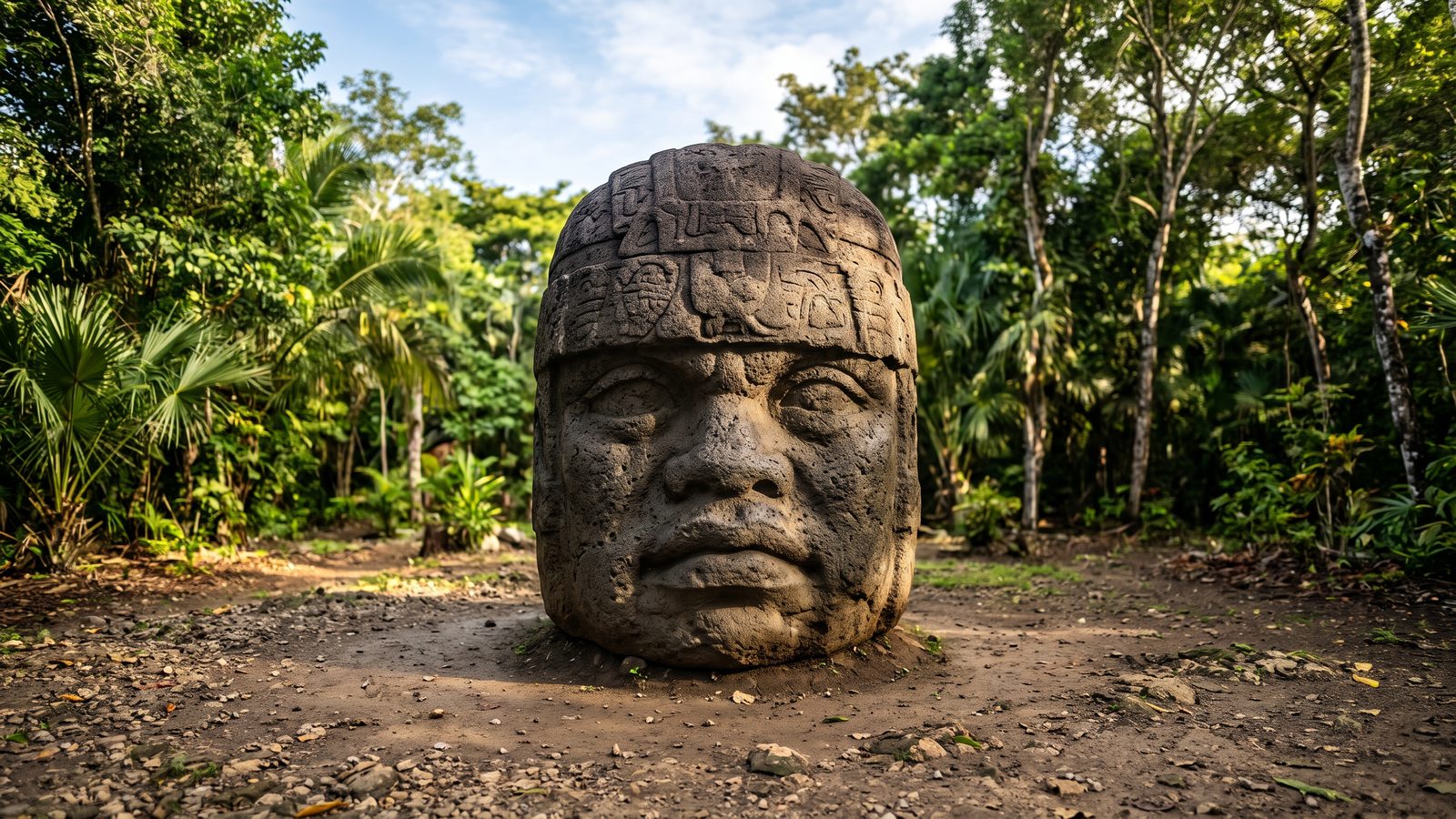
Welcome to this self-guided audio exploration of Olmec Colossal Head 4, one of the most enigmatic and powerful monuments of ancient Mesoamerica. Carved nearly three thousand years ago from a single block of volcanic basalt, this impressive monolith reflects the artistic height and political authority of the Olmec civilization. As you stand before its imposing presence, prepare to unravel the stories behind its creation, symbolism, and discovery.
Discover how ancient artisans shaped tough stone using precise techniques and how massive boulders were moved across vast distances. This tour guides you through the history, artistic features, archaeological secrets, and cultural impact of Mesoamerica's foundational 'mother culture,' giving you a deeper appreciation for this timeless masterpiece.
What you'll hear on this tour
Stop 1. The Mother Culture's Royal Emblem
As you stand before Colossal Head 4, you are observing a profound emblem of the Olmec civilization, Mesoamerica's foundational 'mother culture.' Thriving along the Gulf Coast between 1400 and 400 BCE, the Olmecs intertwined spirituality with daily governance. Look closely at the intricate headdress carved directly into the basalt rock. This feature signifies high elite status, likely belonging to a revered ruler or a powerful shaman. The stylized yet individual facial details hint at a specific ruler's personal lineage, a key factor in dictating social standing. Beyond governance, these massive stone heads served as potent tools for spiritual communion and political influence, echoing through Mesoamerican history.
Stop 2. Masterful Artistry in Volcanic Stone
You stand before a masterpiece crafted from dense basalt, a volcanic rock chosen for its durability and symbolic weight. Notice how the Olmec artisan seamlessly conveys authority through delicate facial contours and symmetrical balance. The curve of the lips flows into the defined jawline, creating a striking visual harmony. Observe the detailed headdress; its subtle patterns evoke the sophisticated woven textiles of the ancient Olmec world. Masons polished this stone using sand and water, achieving a smooth surface that interacts dynamically with natural sunlight. As light and shadow shift across the head throughout the day, the sculpture's expression appears to subtly change before your eyes.
Stop 3. Engineering Feats of Monumental Scale
Observe the sheer scale of this colossal basalt monolith. Quarried from distant volcanic mountains, Olmec engineers transported this massive stone weighing several tons across rugged terrain long before modern machinery. Masons carved the tough basalt using even harder stone tools, combined with abrasives like sand and water to achieve fine precision. Notice the carefully sculpted brow ridge, which gives the face its stern and commanding presence, alongside broad nostrils and full lips typical of Olmec design. The immense weight and refined craft demonstrate an extraordinary mastery of leverage, manpower, and architectural logistics, proving that ancient Mesoamericans possessed engineering capabilities far beyond simple primitive methods.
Stop 4. Uncovering Ancient Secrets
As you examine Colossal Head 4, consider the meticulous work archaeologists perform to unlock its forgotten history. Researchers plot excavation sites with extreme care, sifting delicate soil layers to preserve historical context without damaging artifacts. Modern discoveries rely on advanced non-invasive tools like ground-penetrating radar to explore beneath the earth before digging begins. Laboratory analysis of the basalt surface reveals tiny traces of ancient pigment, proving these majestic monuments were originally painted in vibrant colors. By documenting every microscopic tool mark and radiocarbon-dating nearby organic materials, archaeologists continue to transform scattered clues into a clearer narrative of Olmec life and craftsmanship.
Stop 5. Echoes of the First Mesoamerican Rulers
Envision the thriving Olmec society around 900 BCE as you gaze upon this imposing stone head. Revered as Mesoamerica’s 'mother culture,' the Olmecs pioneered monumental stonework that laid religious and iconographic foundations for later civilizations, including the Maya and Aztecs. Scholars believe these heads represent specific historical rulers or divine guardians, sculpted to project authority and offer divine protection over their communities. Workers moved these multi-ton basalt boulders across vast distances from volcanic quarries, likely utilizing log rollers and communal coordination. Standing here today, you witness an enduring legacy of leadership, engineering, and spiritual power that shaped an entire continent.
Stop 6. Symbols of Earth and Divine Power
Looking at this massive sculpture, you are connecting directly with a civilization that flourished over three thousand years ago. The choice of volcanic basalt connects the carving directly to the earth's raw energy. Transporting these massive multi-ton stones from distant mountains required extraordinary logistics, utilizing land pathways and river routes through massive communal effort. These stone giants were never merely decorative; they stood as stoic symbols of political power and spiritual authority. The stoic gaze carved into this face was positioned with intention, looking out toward a sacred horizon that held deep cosmic meaning for the ancient Olmec world.
Planning your visit
- Best time to go
- Morning hours for softer natural light and cooler temperatures.
- Approximate duration
- About 30 to 45 minutes
- Where to start
- Directly in front of Olmec Colossal Head 4.
Access and conditions change seasonally — check the official site before you go.
Frequently asked questions
Is Olmec Colossal Head 4 worth visiting?
Yes, Olmec Colossal Head 4 is remarkable for its incredible preservation, intricate carved headdress, and historical importance as a primary monument of Mesoamerica's 'mother culture.'
How long do you need at Olmec Colossal Head 4?
Most visitors spend between 30 and 45 minutes examining the monumental carvings, taking photographs, and listening to the audio stops.
Who carved Olmec Colossal Head 4 and when?
It was carved by skilled artisans of the Olmec civilization around 900 BCE, using volcanic basalt quarried from distant mountains.
Keep exploring
Header image is an AI-generated illustration of Olmec Colossal Head 4. AllTours.ai is an AI audio tour guide — point your camera at any landmark and hear its story.