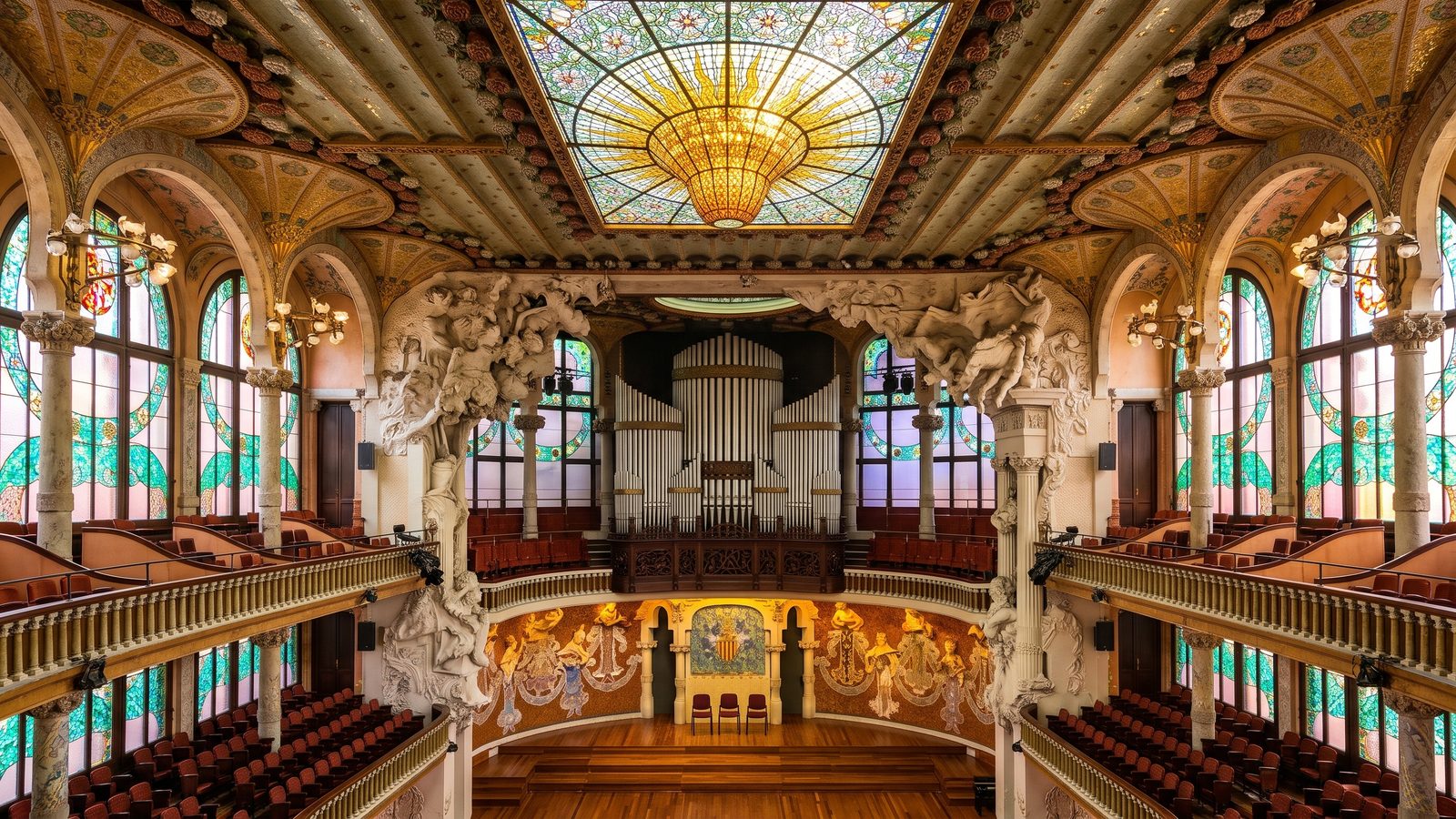
Welcome to Palau de la Música Catalana, a glittering jewel of Catalan Modernisme nestled in the heart of Barcelona. Built between 1905 and 1908 by visionary architect Lluís Domènech i Montaner, this iconic concert hall stands as a glowing tribute to Catalan identity and the artistic revival known as the Renaixença. Prepare to explore a world where light, stone, ceramic tiles, and music blend seamlessly.
As you walk through these light-filled halls, you will trace the history of the Orfeó Català choral society, marvel at the breathtaking inverted stained-glass dome, and uncover how this democratic civic temple became a world-renowned UNESCO World Heritage site celebrating sound, art, and natural organic beauty.
What you'll hear on this tour
Stop 1. Domènech i Montaner's Modernist Symphony
You step inside a living poem of stone, iron, and glass. Architect Lluís Domènech i Montaner uses an innovative iron skeleton to free the interior walls from load-bearing duties, allowing natural light to wash over every detail. Outside, you see exuberant floral mosaics, intricate brickwork, and sculpted busts of musical giants like Beethoven and Wagner. Inside, every archway, column, and ceramic surface flows with organic forms, blurring the boundary between engineering and decorative art. As your eyes rise toward the celestial sky, you realize how this revolutionary design creates an immersive, multi-sensory experience where architecture and nature harmoniously intertwine.
Stop 2. The Heavenly Stained-Glass Dome
You gaze upward at the magnificent inverted stained-glass dome created by Antoni Rigalt i Blanch. Bathed in golden and blue hues, this celestial skylight floods the hall with natural sunlight while depicting a stunning choir of women. Nearby, Eusebi Arnau's sculpted muses burst dynamically from the proscenium arch, each holding a different instrument, while Miquel Blay's mythical figures of Pegasus and the Valkyries add dramatic grandeur. Vibrant mosaic patterns by Lluís Brú adorn exterior columns, echoing the organic philosophy of Modernisme. Everywhere you look, ceramic flowers, detailed leaves, and sculpted composer busts turn the entire venue into an extraordinary living canvas.
Stop 3. Born from the Catalan Renaixença
You stand inside a monument forged during a profound cultural awakening: the Catalan Renaixença. In 1905, the pioneering Orfeó Català choral society commissioned Lluís Domènech i Montaner to design a home reflecting Catalan identity. Completed in just three years by 1908, this masterpiece was financed not by monarchs, but by thousands of public subscriptions and generous local patrons. You witness a testament to collective spirit, where every mosaic tile and stained-glass panel carries symbolic pride. The building rapidly became the cultural epicenter of Barcelona, securing the city's place on the global artistic stage and remaining a vibrant civic temple.
Stop 4. Exceptional Acoustics and Musical Legends
You take a seat in the concert hall and immediately notice its incredible natural acoustics, designed to carry every soft note and dramatic flourish directly to your ears without artificial amplification. This space is engineered like a finely tuned instrument. You walk where legendary classical maestros such as Richard Strauss and Igor Stravinsky, along with flamenco masters and jazz icons, made musical history. Framed by sculpted muses, the stage transforms every performance into a shared visual and auditory journey. Whether attending an intimate chamber recital or a grand orchestral concert, you feel the sound resonate deeply through the very fabric of the building.
Stop 5. A Democratic Temple for Catalan Identity
You explore a building that serves as the soul of Catalan cultural pride. Conceived as a democratic temple of art funded by public contributions, the Palau reflects the vision of the Orfeó Català choir. These founders acted as cultural custodians, blending traditional Catalan folk music with grand classical compositions. Look closely at the allegorical sculptures and intricate mosaics around you—they honor universal musical masters alongside local folk stories and traditions. You realize this venue was never just an elite performance space, but a vibrant sanctuary meant to bring music and civic heritage to everyone.
Stop 6. Intimate Magic on the Stage
You imagine standing on stage in this horseshoe-shaped hall, feeling an extraordinary connection with the audience surrounding you. Sunlight filters through the stained-glass dome during daytime matinees, casting a sacred glow across the stage, while warm artificial lights illuminate the proscenium at night, making the sculpted muses seem actively engaged. Beyond grand classical symphonies, this venue hosts traditional sardana dance music, choral gatherings, and moving poetry recitals. Every artist who performs here enters an inspiring dialogue with Catalan history, participating in a living legacy where sound, space, and audience unite in perfect harmony.
Planning your visit
- Best time to go
- Morning or early afternoon on sunny days to experience maximum light filtering through the stained-glass dome.
- Approximate duration
- About 1 to 1.5 hours
- Where to start
- Main foyer inside the entrance on Carrer del Palau de la Música.
Access and conditions change seasonally — check the official site before you go.
Frequently asked questions
Is Palau de la Música Catalana worth visiting?
Yes, it is widely considered one of Barcelona's top architectural and cultural landmarks. As a UNESCO World Heritage site, its breathtaking Modernist design, iconic stained-glass dome, and rich history make it a must-see destination.
How long do you need at Palau de la Música Catalana?
Most visitors spend between 60 to 90 minutes exploring the foyer, main concert hall, and decorative balconies, allowing ample time to appreciate the detailed art and architecture.
When was Palau de la Música Catalana built and who designed it?
It was designed by Modernist architect Lluís Domènech i Montaner for the Orfeó Català choral society. Construction began in 1905 and was completed in 1908.
Keep exploring
Header image is an AI-generated illustration of Palau de la Música Catalana. AllTours.ai is an AI audio tour guide — point your camera at any landmark and hear its story.