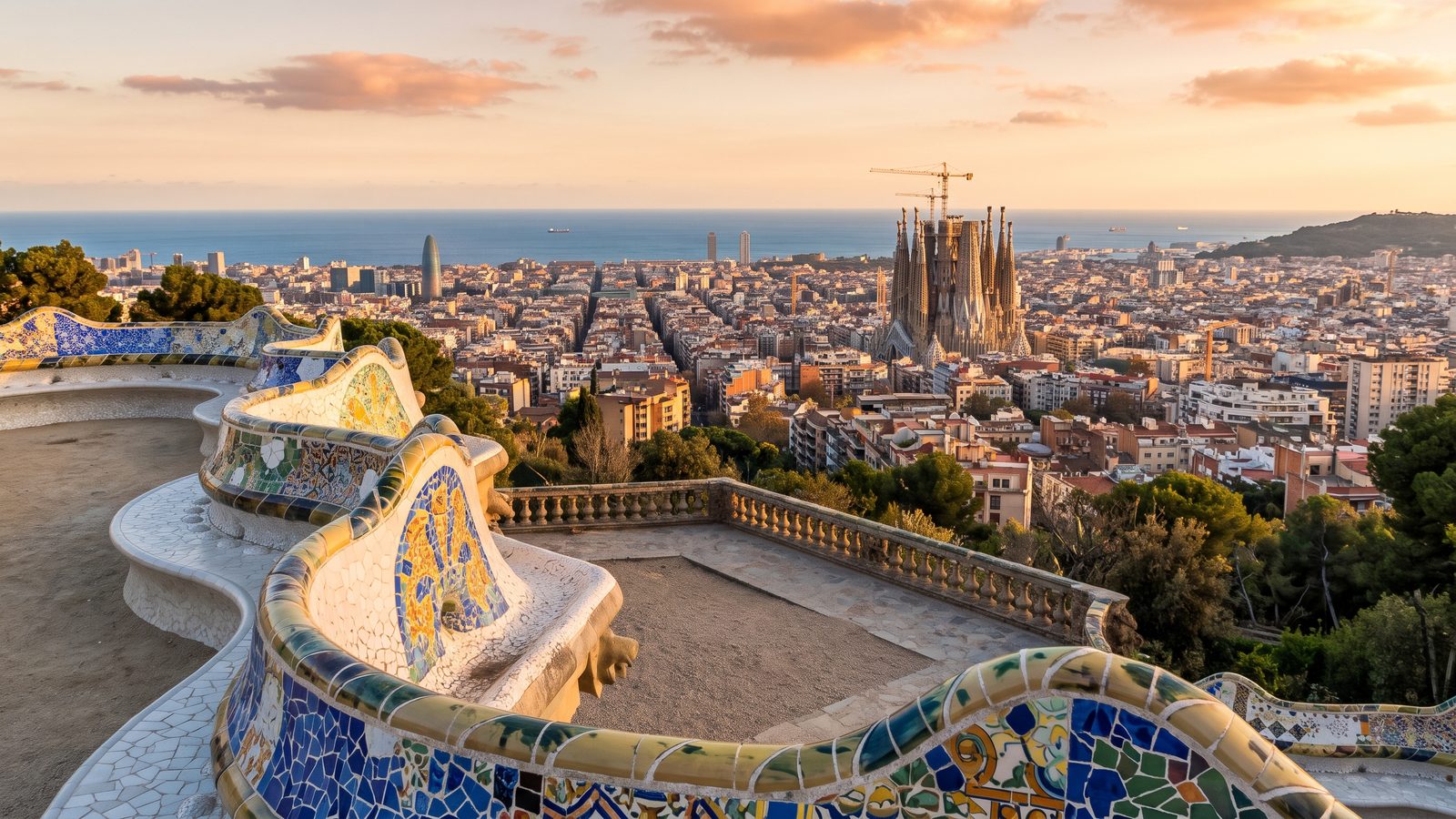
High above Barcelona, Park Güell stands as one of Antoni Gaudí’s most ambitious creations. What began in 1900 as an exclusive residential garden city commissioned by industrialist Eusebi Güell eventually transformed into an extraordinary public sanctuary. As you explore this UNESCO World Heritage Site, you step directly into a realm where architectural imagination meets the contours of nature, revealing a vibrant tapestry of Catalan Modernisme high above the Mediterranean.
On this self-guided audio tour, you will navigate winding stone paths, admire playful mosaic art, and discover hidden grottoes. Feel the magic of Gaudí’s organic design as you take in sweeping urban panoramas, legendary modernista sculptures, and lush Mediterranean gardens designed to harmonize completely with the surrounding hillside.
What you'll hear on this tour
Stop 1. Panoramic Sweeps of the Mediterranean City
You stand atop Gaudí's grand terrace, gazing out across an impressive panorama of Barcelona. The main platform opens to an unobstructed view stretching from the glittering Mediterranean Sea to the surrounding hills. To your left, the amusement park on Tibidabo crowns the peak, while Montjuïc frames the right skyline. Looking closely at the urban grid, you easily spot the soaring spires of the Sagrada Família standing proudly amidst the city fabric. Further east, the bullet-shaped Agbar Tower catches the sunlight, illustrating Barcelona's architectural journey. Framed by Gaudí’s colourful, organic creations, this strategic vantage point offers a breathtaking perspective on the layout, history, and natural edges of Catalonia’s capital.
Stop 2. Mythic Creatures and Fairytale Entrance Gatehouses
As you approach the main staircase, you encounter the famous mosaic dragon, often called the salamander, guarding the pathway. Covered in intricate colorful tiles, this striking sculpture evokes mythic guardians like Python or ancient alchemical symbols of fire. Below, two fairytale gatehouses flank the park entrance, featuring conical roofs and dreamlike details that instantly pull you into Gaudí’s whimsical narrative. Looking up inside the Hypostyle Room, notice the artistic ceiling medallions depicting celestial bodies and agricultural themes, transforming structural columns into a heavenly gallery. Every sculpted curve, bright tile, and decorative accent throughout this space reflects Gaudí’s deep artistic language, inviting you to decode hidden meanings behind his fantastical designs.
Stop 3. Organic Forms and Dynamic Mosaic Trencadís
Notice how Gaudí rejects rigid straight lines in favor of forms that embrace the natural contours of the hillside. Inclined stone columns support the structures above while mimicking natural tree trunks to distribute weight efficiently. Look closely at the famous trencadís mosaics covering the curved surfaces; Gaudí crafted these brilliant patterns using recycled ceramic shards, broken glass, and discarded bottles. This innovative technique allows for smooth, curvilinear shapes like the ergonomic serpentine bench, designed to comfortably support your back while offering sweeping city views. Nearby viaducts resemble ancient Roman aqueducts, yet their flowing arches and rustic stonework blend seamlessly into the terrain, demonstrating an inventive modernista approach to engineering.
Stop 4. A Modernista Manifesto of Catalan Identity
You are experiencing a core masterpiece of Catalan Modernisme, a cultural movement that championed a distinct national identity through creative arts. Gaudí weaves Christian symbolism and ancient Catalan folklore directly into the stone and tile around you, creating a deep spiritual narrative. Originally conceived as a utopian estate for wealthy families seeking clean air away from industrial factories, the park reflects early twentieth-century aspirations for harmonious living. The mosaic dragon on the staircase serves as a protective guardian rooted in local lore. Now a public sanctuary and UNESCO World Heritage Site, this space has evolved from an elite residential dream into a shared cultural treasure celebrating Catalan heritage.
Stop 5. From Utopian Housing Venture to Public Park
You stand on ground originally planned in 1900 as an exclusive residential estate. Industrialist Eusebi Güell commissioned Antoni Gaudí to build sixty luxury homes inspired by the English garden city movement. However, the remote location and radical designs deterred conservative buyers, leading to financial failure with only two houses ever sold. Gaudí himself bought one of the homes and lived here for nearly two decades, while Güell resided in the property's existing mansion. Construction halted in 1914, leaving the estate unfinished. Following Güell's death, his heirs sold the land to the Barcelona City Council in 1922, officially opening it as a public park in 1926.
Stop 6. Terraced Groves and Integrated Mediterranean Flora
As you wander the winding pathways, observe how Gaudí integrates native Mediterranean vegetation directly into his structural design. Stone viaducts and inclined columns support terraced groves of palm trees, carob trees, and fragrant rosemary bushes. You walk past hidden grottoes and shaded alcoves filled with the scent of wild thyme and pine. Notice how the hillside terracing preserves the natural topography while creating a multi-layered botanical environment. Gaudí even designed an ingenious drainage system that collects rainwater through hidden channels to nourish the surrounding gardens. Vibrant bougainvillea drapes over stone walls, turning native flora into a living tapestry that changes continuously with the Mediterranean seasons.
Planning your visit
- Best time to go
- Early morning or late afternoon to enjoy optimal golden light across Barcelona and avoid peak crowds.
- Approximate duration
- About 1.5 to 2 hours
- Where to start
- Main entrance on Carrer d'Olot near the two fairytale gatehouses and the dragon staircase.
Access and conditions change seasonally — check the official site before you go.
Frequently asked questions
Is Park Güell worth visiting?
Yes, Park Güell is a UNESCO World Heritage site and one of Barcelona's most famous landmarks, renowned for Antoni Gaudí's colorful trencadís tilework, serpentine benches, and magnificent views of the city.
How long do you need at Park Güell?
Most visitors spend between 1.5 and 2 hours walking through the park's main architectural zones, terraced gardens, and scenic viewpoints.
Why was Park Güell built?
Park Güell was originally commissioned in 1900 by industrialist Eusebi Güell as an exclusive residential housing estate inspired by the English garden city movement, though it was later acquired by the city and opened as a public park in 1926.
Keep exploring
Header image is an AI-generated illustration of Park Güell. AllTours.ai is an AI audio tour guide — point your camera at any landmark and hear its story.