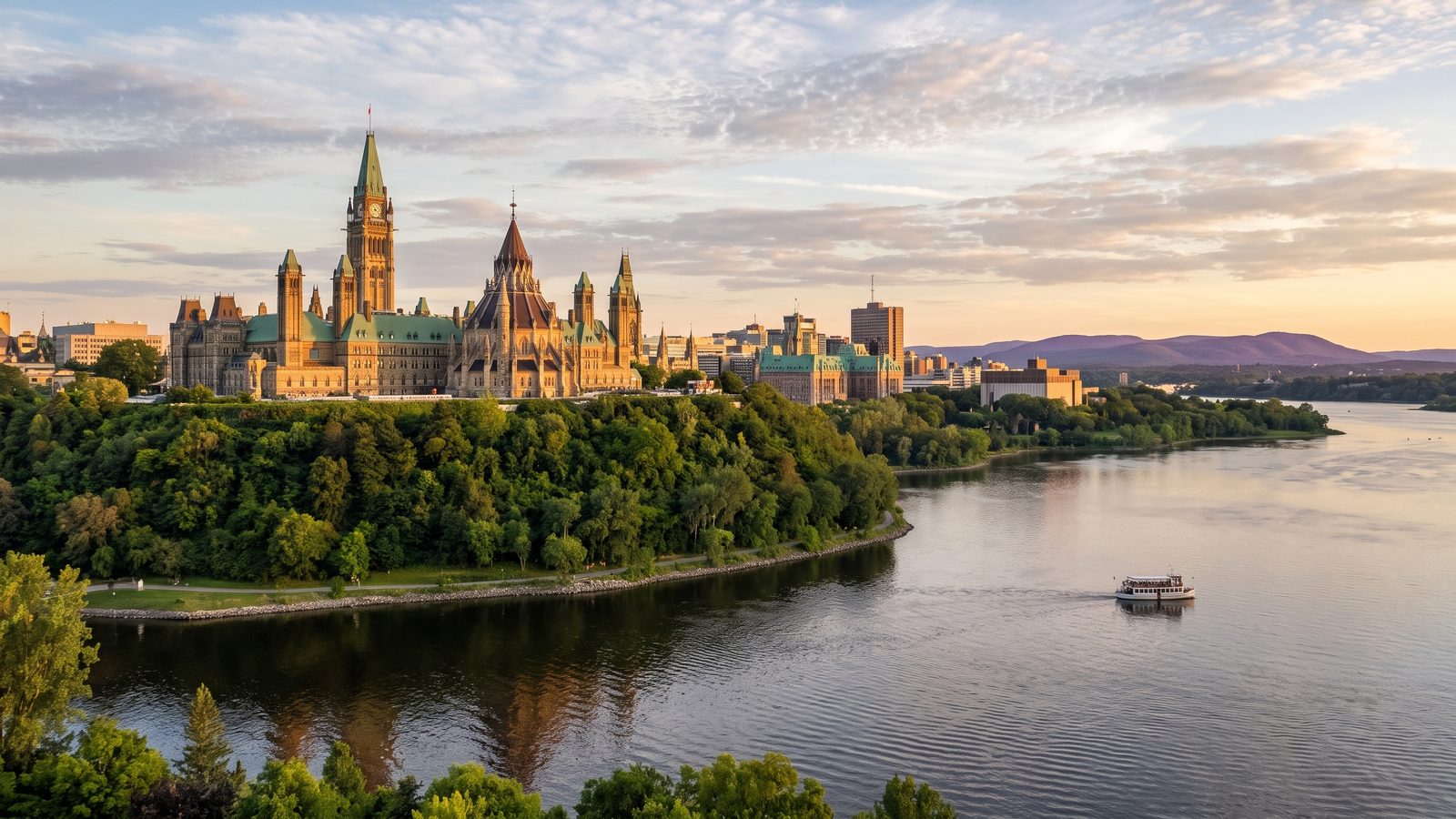
Welcome to Parliament Hill, the beating heart of Canadian democracy perched high above the majestic Ottawa River. Chosen as the nation's capital by Queen Victoria in 1857, this historic site showcases striking High Victorian Gothic architecture, soaring spires, and sweeping landscapes. As you walk these sacred grounds, you step into a living canvas of nationhood, where historic decisions, royal legacy, and architectural grandiosity converge overlooking the water.
This comprehensive self-guided audio tour guides you through the stories carved into sandstone and cast in bronze. From majestic ceremonial guard changes to panoramic river vistas, you will experience the rich, evolving tapestry of Canada's political identity and artistic heritage at your own comfortable pace.
Listen to a sample
The opening of this tour, exactly as AllTours narrates it on site.
What you'll hear on this tour
Stop 1. High Victorian Gothic in Sandstone
You stand before the monumental Centre Block, where Canadian High Victorian Gothic architecture transforms raw stone into national narrative. You observe smooth sandstone blocks contrasting against rough-hewn granite foundations, rooting the majestic structure to the bluff. Look up to discover whimsical gargoyles and grotesques peering down, featuring native Canadian wildlife like beavers and moose alongside allegorical figures of provincial virtues. Intricate stone tracery adorns every window while elegant flying buttresses channel structural weight downward with quiet precision. Crowning the edifice, iconic copper roofs display a rich verdigris patina, adding a distinct Canadian hue that deepens over time. Every carved detail invites your close inspection.
Stop 2. Queen Victoria's Strategic Capital Choice
You walk upon ground selected by Queen Victoria in 1857, a strategic compromise that ended intense rivalry among candidate cities. You stand high on a bluff far from the American border, a natural fortress once serving as military barracks overlooking Chaudière Falls. Imagine Victorian laborers quarrying Nepean sandstone with rudimentary tools starting in 1859. By 1866, the original structures stood complete, welcoming the first Parliament of the Dominion of Canada in 1867. Though a devastating fire reshaped the skyline in 1916, this elevated site remains the crucible where Canada's political identity took root, carrying historical memory forward into the present day.
Stop 3. Stories Carved in Stone and Bronze
You explore a living gallery of Canadian heritage across the grounds and facades. Monumental bronze statues of past prime ministers like Sir John A. Macdonald stand on the lawns, capturing historic legacies through classical and realist sculpture. As you draw nearer to the stonework, masterfully carved maple leaves, fleurs-de-lis, and playful grotesques emerge from the walls as architectural guardians. Inside the Peace Tower's Memorial Chamber, vibrant stained-glass windows filter light into vivid scenes of wartime sacrifice. These detailed artistic elements transform Parliament Hill into an expansive canvas, reflecting generations of craftsmanship and national identity that you can touch and admire.
Stop 4. Panoramas Across River and Shield
You gaze out from this high plateau across a dramatic tapestry of Canadian geography. The Ottawa River flows below you, an ancient Indigenous trade route and lumber highway defining the provincial border. Looking across the water, you spot Gatineau, Quebec, linked to Ontario by historic bridges. To the north, the ancient rolling Gatineau Hills frame the horizon, displaying the venerable Canadian Shield's seasonal colors. Near the East Block, you observe the mouth of the Rideau Canal, a UNESCO World Heritage site meeting the river. Downstream, the faint roar and mist of Chaudière Falls remind you of the land's deep, enduring sacred heritage.
Stop 5. Rhythms of Tradition and Spectacle
You feel the rhythmic heartbeat of national tradition echoing across the grounds. On summer mornings, you watch the Changing of the Guard as forces in iconic scarlet tunics and bearskin hats march in clockwork precision to regimental music. At precisely noon, the sharp report of the Noon Day Gun resounds across Ottawa, preserving a timekeeping custom from nineteenth-century garrison days. Beyond daily routines, you stand on the stage for major national events. Imagine a vibrant sea of red and white gathering here for Canada Day fireworks, or the quiet reverence descending during solemn Remembrance Day observances at the nearby National War Memorial.
Stop 6. The Living Process of Governance
You stand at the center of Canadian democracy, where elected representatives directly connect citizens to responsible government. Inside these walls, Members of Parliament represent constituencies from across the nation, debating policy and shaping laws on your behalf. You reflect on the symbolic ceremonial Mace carried daily into the House of Commons, representing the Speaker's authority and the sovereign power of the people. This ground marks a continuous journey of expanding voting rights, evolving from restricted male suffrage toward universal inclusivity. Every debate, question, and vote taking place here reinforces government accountability to the public, inviting you to participate in an ongoing democratic legacy.
Planning your visit
- Best time to go
- Summer mornings around 9:30 AM to watch the Changing of the Guard and enjoy optimal light on the main lawn.
- Approximate duration
- About 1 to 1.5 hours
- Where to start
- Plaza in front of the Centre Block, near the Centennial Flame.
Access and conditions change seasonally — check the official site before you go.
Frequently asked questions
Is Parliament Hill worth visiting?
Yes, Parliament Hill is Ottawa's central landmark, renowned for its High Victorian Gothic architecture, rich Canadian history, vibrant summer ceremonies, and expansive views across the Ottawa River.
How long do you need at Parliament Hill?
Most visitors spend between 1 and 2 hours walking the grounds, exploring outdoor sculptures, and admiring panoramic viewpoints across the river.
Why was Parliament Hill chosen as Canada's capital location?
Queen Victoria selected Ottawa in 1857 because its inland position offered defense against potential American attacks while maintaining river transport access.
Keep exploring
Header image is an AI-generated illustration of Parliament Hill. AllTours.ai is an AI audio tour guide — point your camera at any landmark and hear its story.