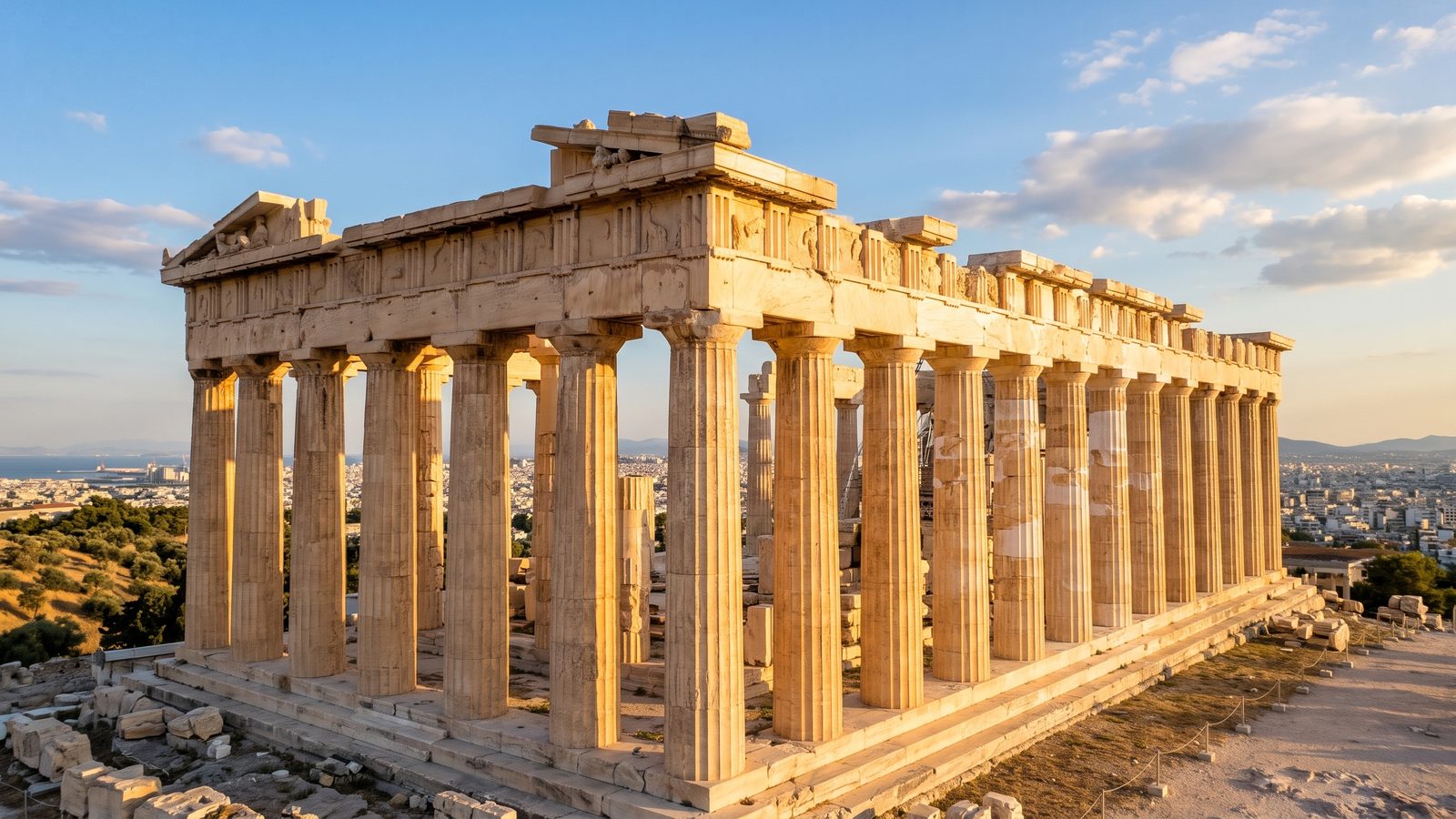
Step onto the Acropolis hill and experience the majestic Parthenon, the ultimate symbol of ancient Greek civilization, democracy, and architectural genius. Built in the fifth century BC to honor Athena Parthenos, this masterwork of Doric design dominates the skyline of Athens. As you explore its towering Pentelic marble columns, you will uncover a story of resilience, innovation, and intense artistic passion that shaped the Western world.
This self-guided audio tour leads you around the temple's iconic features. You will discover secret optical illusions engineered by ancient architects, learn how the structure survived catastrophic war explosions, and imagine the vibrant colors, sacred processions, and gold-and-ivory statue that once defined this extraordinary sacred site.
Listen to a sample
The opening of this tour, exactly as AllTours narrates it on site.
What you'll hear on this tour
Stop 1. Optical Illusions in Pentelic Marble
Look closely at the monumental marble structure before you. This classical Doric temple is a masterclass in optical illusion and mathematical precision. You stand on the stylobate, a platform that subtlely curves upward toward the center to prevent the visual illusion of sagging against the Athenian sky. As you gaze at the columns, notice how they swell slightly in the middle—a technique called entasis that gives them dynamic tension. Every column leans imperceptibly inward, while the corner columns are built thicker to absorb more light. Crafted from shimmering Pentelic marble quarried nearby, every calculated deviation from a straight line creates a breathtaking sense of visual perfection.
Stop 2. The Thunderous Explosion of 1687
As you stand before these magnificent ruins, you gaze at a dramatic turning point in history. The large gap in the center wall is not from gradual weathering, but from a catastrophic event in 1687. During a Venetian bombardment, a cannonball hit the Ottoman gunpowder magazine stored inside the temple, causing a massive explosion that instantly shattered the ancient sanctuary. You can see scattered marble drums across the site, revealing ingenious dry masonry techniques where column blocks fitted together seamlessly without mortar. Despite centuries of battle, earthquakes, and neglect, modern conservators work tirelessly to reassemble these resilient stones, keeping the site's ancient glory alive.
Stop 3. Rising from Persian Ashes
You look upon a monument born from devastation and immense political ambition. In 480 BC, invading Persian forces sacked Athens, destroying the earlier temple dedicated to Athena on this hilltop. The Athenians swore an oath not to rebuild their sacred shrines until they vanquished their enemies. Decades later, under the statesman Pericles and funded by the Delian League, Athens began constructing this masterwork in 447 BC. Completed in just nine years by 438 BC, the building stands as a testament to the Golden Age of Athenian power and democracy. You are walking through the physical manifestation of a city's triumph, wealth, and spiritual devotion.
Stop 4. Golden Splendor of the Ancient Cella
Imagine stepping back to 438 BCE during the Parthenon's grand dedication. You are not standing beside modern ruins, but inside the gleaming heart of ancient Athenian power. Architects Iktinos and Kallikrates, guided by master sculptor Phidias, bring Pericles' grand vision to life. Inside the cella, you would stand humbled before the colossal chryselephantine statue of Athena Parthenos, shimmering in massive gold and ivory. Vibrant reds, blues, and golds painted on the outer pediments illustrate mythical battles and Athena's birth, while the revolutionary Panathenaic Frieze honors everyday citizens. Beyond a place of worship, this magnificent sanctuary also serves as the imperial treasury of the Delian League.
Stop 5. The Civic Heart of Athenian Idealism
You stand where ancient citizens once gathered for the grand Panathenaic Festival, celebrating their civic pride and devotion to Athena. This site represents far more than a temple; it embodies the cultural soul of democratic Athens. As a massive public works project, citizens collectively funded and built this sanctuary, expressing their commitment to civic duty, reason, and harmony. The deliberate balance of its design reflects the core cultural value of sophrosyne—moderation and balance achieved through mathematical precision. Here, amid a golden age of drama, philosophy, and self-governance, the Parthenon serves as an enduring stage for the Athenian spirit and the foundations of Western thought.
Stop 6. A Blueprint for Global Architecture
As you behold these ancient columns, you are examining the foundational architectural DNA of Western civilization. The Parthenon’s refined Doric proportions and subtle optical corrections established a visual language of authority and civic pride that continues to shape our world today. You can spot its lasting architectural legacy in courthouses, capitol buildings, and museums across Europe and North America. Beyond its physical stone columns, this monument represents the birth of democratic ideals and philosophical inquiry. You are experiencing a timeless testament to human potential, an enduring treasure that has inspired thinkers, artists, and builders for over two millennia.
Planning your visit
- Best time to go
- Early morning at opening or late afternoon to avoid heavy crowds and heat.
- Approximate duration
- about 1 to 1.5 hours
- Where to start
- At the main entrance gate of the Acropolis archaeological site.
Access and conditions change seasonally — check the official site before you go.
Frequently asked questions
Is the Parthenon worth visiting?
Yes, visiting the Parthenon is an unmissable experience. As the supreme symbol of Classical Greek architecture and Western civilization, seeing its monumental marble columns and refined design in person offers an unmatched connection to ancient history.
How long do you need at the Parthenon?
Most visitors spend between 1 to 2 hours exploring the Parthenon and the surrounding Acropolis complex. This allows enough time to walk around the monument, take photos, and listen to the audio tour stories.
Why was the Parthenon built?
The Parthenon was built between 447 and 438 BC under the leader Pericles as a temple to Athena Parthenos, the patron goddess of Athens. It celebrated victory over invading Persian forces, demonstrated Athenian power and democracy, and housed the Delian League treasury.
Keep exploring
Header image is an AI-generated illustration of Parthenon. AllTours.ai is an AI audio tour guide — point your camera at any landmark and hear its story.