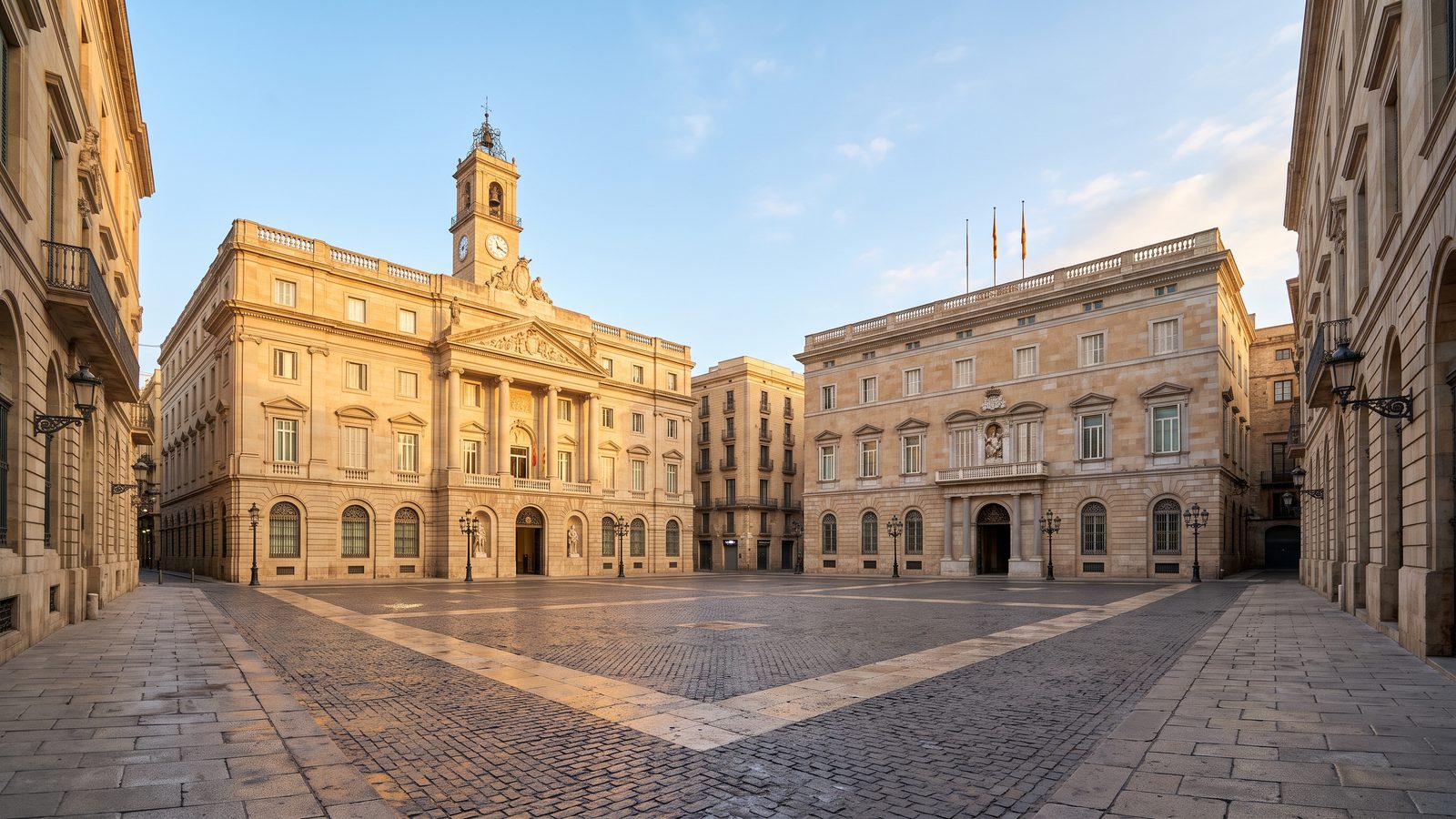
Step into Plaça de Sant Jaume, the historical and political heart of Barcelona. Standing on ground that once hosted the ancient Roman forum of Barcino, this iconic open square places you directly between the Palau de la Generalitat and the Ajuntament. As you explore the space, you will discover how medieval governance, groundbreaking architecture, and vibrant Catalan traditions have intersected here across two millennia of city history.
This self-guided audio tour walks you through the plaza's dramatic history, contrasting architectural styles, and cultural spectacles. Learn about centuries of civic authority, political struggles, and community celebrations that have unfolded across these very stones, right in the center of Barcelona's historic Gothic Quarter.
What you'll hear on this tour
Stop 1. Two Millennia at Barcelona's Core
You stand on ground that has served as Barcelona's political heart for two thousand years. Beneath your feet lie the remnants of the Roman forum of Barcino, where the Temple of Augustus once directed daily life. As the city evolves into medieval Barcelona, this square retains its governing role through the Consell de Cent and the Generalitat de Catalunya. The open plaza you see today takes shape in the nineteenth century after workers demolish medieval streets to create a grand stage. Over time, these stones absorb declarations of war, pronouncements of peace, and passionate demonstrations for Catalan autonomy, creating an enduring symbol of political identity.
Stop 2. A Living Dialogue of Civic Power
You stand between two monumental centers of power that face each other across the plaza. To your right, the Palau de la Generalitat traces its roots to the fourteenth-century Diputació del General, serving today as Catalonia's regional authority. Inside, historic chambers like the Saló de Sant Jordi have witnessed centuries of debates shaping the region's quest for autonomy. Directly opposite, the Casa de la Ciutat houses Barcelona’s municipal government, continuing a legacy of self-governance that began in the Gothic Saló de Cent in 1373. From these historic balconies, leaders regularly address the public, making this square the true democratic heart where citizens and institutions meet.
Stop 3. A Duel of Renaissance and Neoclassical Design
Look across the square to witness a striking architectural conversation between two distinct eras. On your left, the Palau de la Generalitat showcases a magnificent late sixteenth-century Renaissance frontage designed by Pere Blai. You observe its harmonious proportions, classical symmetry, and refined portal detailing that introduced humanist elegance to the city. Turning around, you face the Ajuntament, which provides a Neoclassical counterpoint designed by Josep Mas i Vila in the 1830s. Notice its grand scale, clean lines, and imposing columns projecting austere civic authority. Together, these facing facades transform the open plaza into an outdoor gallery of evolving architectural aesthetics.
Stop 4. The Stage for Catalan Tradition
Here, you feel the active pulse of Catalan heritage unfolding in real time. Beyond its political duties, this square serves as a lively stage for profound cultural expression. During major festivals like La Mercè, you witness castellers assembling extraordinary human towers that symbolize unity and collective ambition. You can also picture local dancers forming rhythmic, communal circles for the sardana, an emblem of shared tradition open to everyone. Listening closely, you hear the melodic cadence of the Catalan language echoing off stone walls. In this historic space, ancient traditions are not merely remembered; citizens actively live them every single day.
Stop 5. Capturing Light, Lines, and Human Motion
As you explore with your camera, you find an ever-changing canvas of urban light and shadow. In the morning, low sunlight rakes across the Gothic features of the Casa de la Ciutat, illuminating intricate stone carvings and deep textures. As the afternoon progresses, warm golden light fills the plaza, highlighting the Renaissance features of the Palau de la Generalitat opposite. Step back to frame both monumental facades in a single wide composition, emphasizing their historical dialogue. Look closer to capture candid moments of daily life or vibrant cultural gatherings like casteller human towers, transforming centuries of stone into a living dynamic scene.
Stop 6. Footsteps Across a Living Timeline
As you step onto the ancient flagstones of Plaça de Sant Jaume, you feel the subtle undulations beneath your feet, worn smooth by centuries of activity. Your stride connects directly to the historical footsteps of Roman officials, medieval traders, and modern citizens assembling for civic life. You notice how the square's gentle slope naturally guides your movement toward the historic Carrer de Jaume I, reflecting an urban layout rooted in Roman planning. Walking here is more than moving between landmarks; it is a sensory journey where the acoustic echo of your steps joins two thousand years of history recorded in stone.
Planning your visit
- Best time to go
- Early morning for quiet architectural photography, or late afternoon to experience the square's vibrant civic life.
- Approximate duration
- about 30 minutes
- Where to start
- The center of Plaça de Sant Jaume, facing between the Palau de la Generalitat and the Ajuntament.
Access and conditions change seasonally — check the official site before you go.
Frequently asked questions
Is Plaça de Sant Jaume worth visiting?
Yes, Plaça de Sant Jaume is essential visiting as it serves as the political and historical heart of Barcelona, housing both the Catalan government and City Hall on the site of the ancient Roman forum.
How long do you need at Plaça de Sant Jaume?
You need about 20 to 30 minutes to explore the square, admire the contrasting architectural facades, and take in its rich historical significance.
What is the historical significance of Plaça de Sant Jaume?
It originated as the Roman forum of Barcino and evolved into Catalonia's political center, hosting both the Generalitat de Catalunya and Barcelona's municipal government for centuries.
Keep exploring
Header image is an AI-generated illustration of Plaça de Sant Jaume. AllTours.ai is an AI audio tour guide — point your camera at any landmark and hear its story.