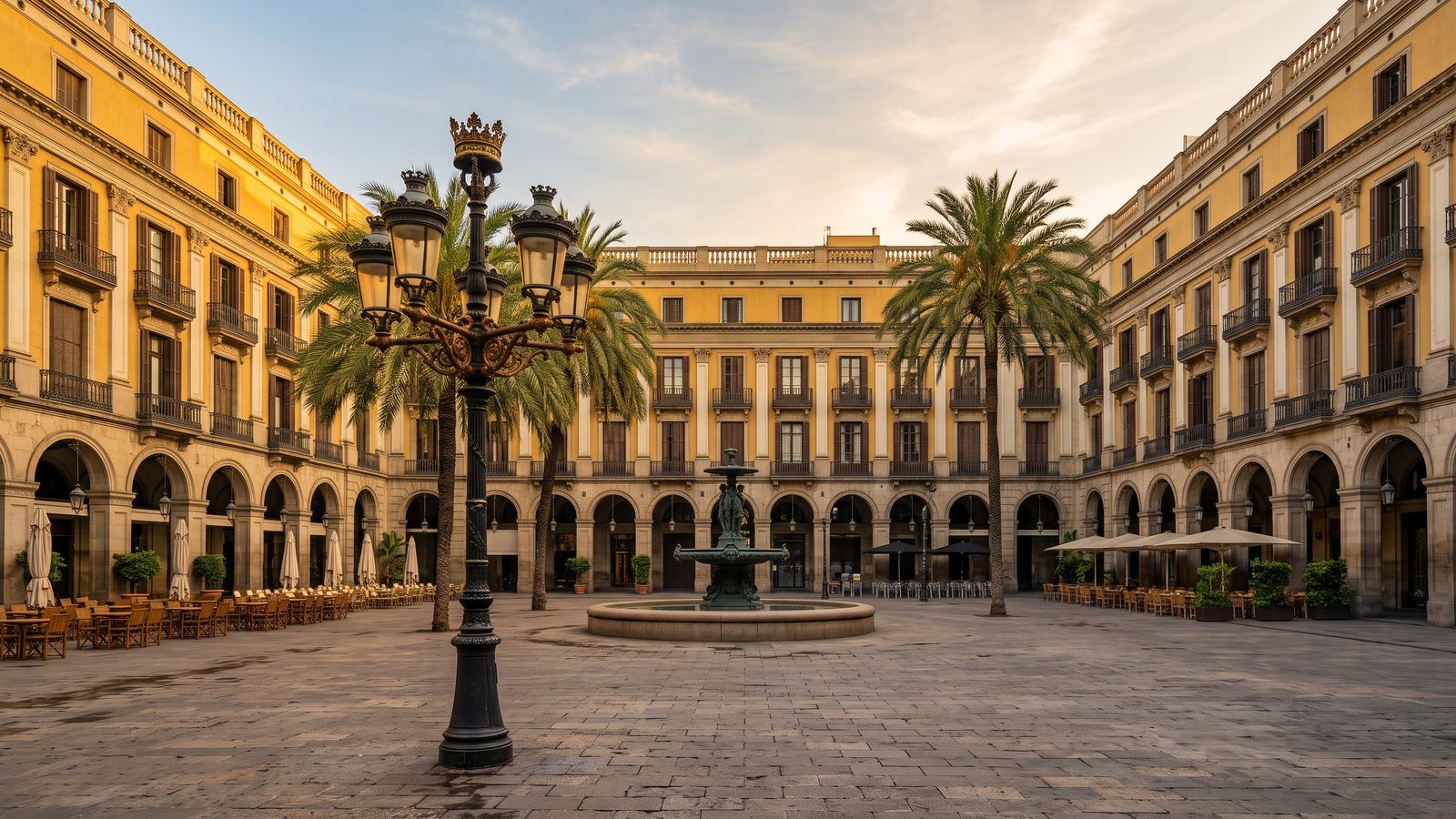
Welcome to Plaça Reial, a captivating Neoclassical plaza nestled in the heart of Barcelona's Gothic Quarter. Designed by Francesc Daniel Molina i Casamajó in the mid-nineteenth century, this lively square rests on the former grounds of a Capuchin convent. As you stroll through its grand arcades, you stand at a bustling intersection of Catalan history, architectural brilliance, culinary traditions, and vibrant nocturnal culture.
This self-guided audio tour walks you through the plaza's fascinating evolution. You will admire Antoni Gaudí's earliest public streetlights, discover bustling Sunday markets, feel the pulse of authentic flamenco rhythms, and uncover the historic jazz venues and terraces that bring this iconic Mediterranean public square to life.
What you'll hear on this tour
Stop 1. From Silent Convent to Bourgeois Plaza
As you stand in this grand square, step back in time before its elegant arcades existed. For centuries, the Capuchin convent of Santa Madrona occupied this ground, offering a quiet monastic sanctuary. Everything changed in 1835 when ecclesiastical confiscations swept across Spain, clearing the land for an ambitious urban redesign. Architect Francesc Daniel Molina i Casamajó won the competition to create a modern Neoclassical square. Construction began in 1848 and lasted until 1859, meticulously transforming the land into a symbol of bourgeois pride. Look closely at the iconic lampposts illuminating the space; young Antoni Gaudí added these in 1879 as his very first urban commission, completing this layered masterpiece.
Stop 2. Symmetrical Arcades and Gaudí's First Genius
Look around you and take in the harmonious Neoclassical symmetry designed by Francesc Daniel Molina. Continuous arcaded galleries enclose the perimeter, providing a sheltered promenade beneath uniform three-story façades. Golden-hued stucco and elegant ironwork balconies reflect the warm Mediterranean light, casting rhythmic patterns across the plaza. At the square's center, pay close attention to Antoni Gaudí’s remarkable streetlights from 1879. You are looking at his earliest public work: distinctive six-armed cast-iron lamps topped with winged helmets representing Mercury, the Roman god of commerce. Entwined serpents and dragons adorn the bases, offering an early hint of the organic, natural forms that would later define his iconic architectural masterpieces.
Stop 3. Spontaneous Flamenco and Living Catalan Rituals
Feel the artistic energy echoing off the stone arcades as you wander through the square. Plaça Reial serves as a vibrant cultural stage where local traditions effortlessly come alive. You may encounter impromptu flamenco performances bringing passionate guitar rhythms to the open air, or witness locals joining hands in a sardana circle—a traditional Catalan folk dance symbolizing unity and community pride. Bohemians, portrait artists, and performers have gathered here for generations. Join in the timeless Mediterranean ritual of the passeig, the evening stroll where residents come to socialize, converse, and connect. As you cross the plaza, you are actively participating in a living tapestry of Barcelona’s authentic public life.
Stop 4. Open-Air Terraces and Culinary Traditions
Take a seat beneath the arches as the aroma of sizzling gambas al ajillo and sweet crema catalana fills the air. Dining in Plaça Reial is a theatrical public tradition where historic terraces spill directly onto the open cobblestones. At Les Quinze Nits, you can enjoy popular traditional paella right amidst the square's energetic pulse. Nearby, Ocaña offers a contemporary culinary experience, seamlessly transitioning from a lively tapas bar to an elegant dining room. For a taste of history, pause near Bar Glaciar, where generations have savored classic bocadillos and small plates. Under the soft glow of Gaudí's lampposts, every bite connects you to centuries of shared Mediterranean feasts.
Stop 5. Jazz Rhythms and Nocturnal Elegance
As dusk settles over Barcelona, watch the square shed its daytime composure and transform into an electric nightlife hub. Beneath the illuminated Neoclassical arcades, legendary music venues come alive. You can step into Jamboree, a historic jazz club whose soulful improvisations have echoed through the plaza for decades, or venture into intimate flamenco tablaos filled with fiery dancing and footwork. Elegant cocktail bars and cozy lounges hum with the sound of clinking glasses and lively international chatter. Gaudí's iron streetlamps cast a dramatic, theatrical glow across the plaza, guiding revelers and music lovers through an unforgettable night where Barcelona’s nocturnal spirit thrives until the early morning hours.
Stop 6. Sunday Stamp Collectors and Artisan Treasures
If you visit on a Sunday morning, you will experience a completely different rhythm within Plaça Reial. The square transforms into a beloved traditional open-air market dedicated to philatelists and numismatists. You can watch passionate collectors browse tables filled with rare vintage stamps, historic coins, and old postcards, each carrying a tangible piece of history. On other days, explore the unique specialty shops tucked beneath the arcades. Rather than standard chain stores, you will discover boutique leather crafters, antique bookdealers, and local art galleries featuring authentic Catalan creations. Hunting for treasures here allows you to bring home a meaningful, handcrafted memento of your time in Barcelona.
Planning your visit
- Best time to go
- Late afternoon through evening for ambient dining and nightlife, or Sunday morning for the stamp and coin market.
- Approximate duration
- About 45 minutes to 1 hour
- Where to start
- Fountain of the Three Graces in the center of Plaça Reial, just off La Rambla.
Access and conditions change seasonally — check the official site before you go.
Frequently asked questions
Is Plaça Reial worth visiting?
Yes, Plaça Reial is one of Barcelona's most famous and vibrant squares. It features beautiful Neoclassical arcades, Antoni Gaudí's very first public urban commission (his 1879 streetlamps), popular outdoor dining terraces, and legendary nightlife venues.
How long do you need at Plaça Reial?
You need about 30 to 60 minutes to explore the architecture, admire Gaudí's lampposts, and take photos. If you stay for tapas, a meal, or live jazz at Jamboree, budget 1.5 to 2 hours.
What is the history behind Plaça Reial?
Plaça Reial stands on land formerly occupied by the Capuchin convent of Santa Madrona, which was cleared following ecclesiastical confiscations in 1835. Architect Francesc Daniel Molina i Casamajó designed the current Neoclassical square, constructed between 1848 and 1859, with Gaudí's streetlamps added in 1879.
Keep exploring
Header image is an AI-generated illustration of Plaça Reial. AllTours.ai is an AI audio tour guide — point your camera at any landmark and hear its story.