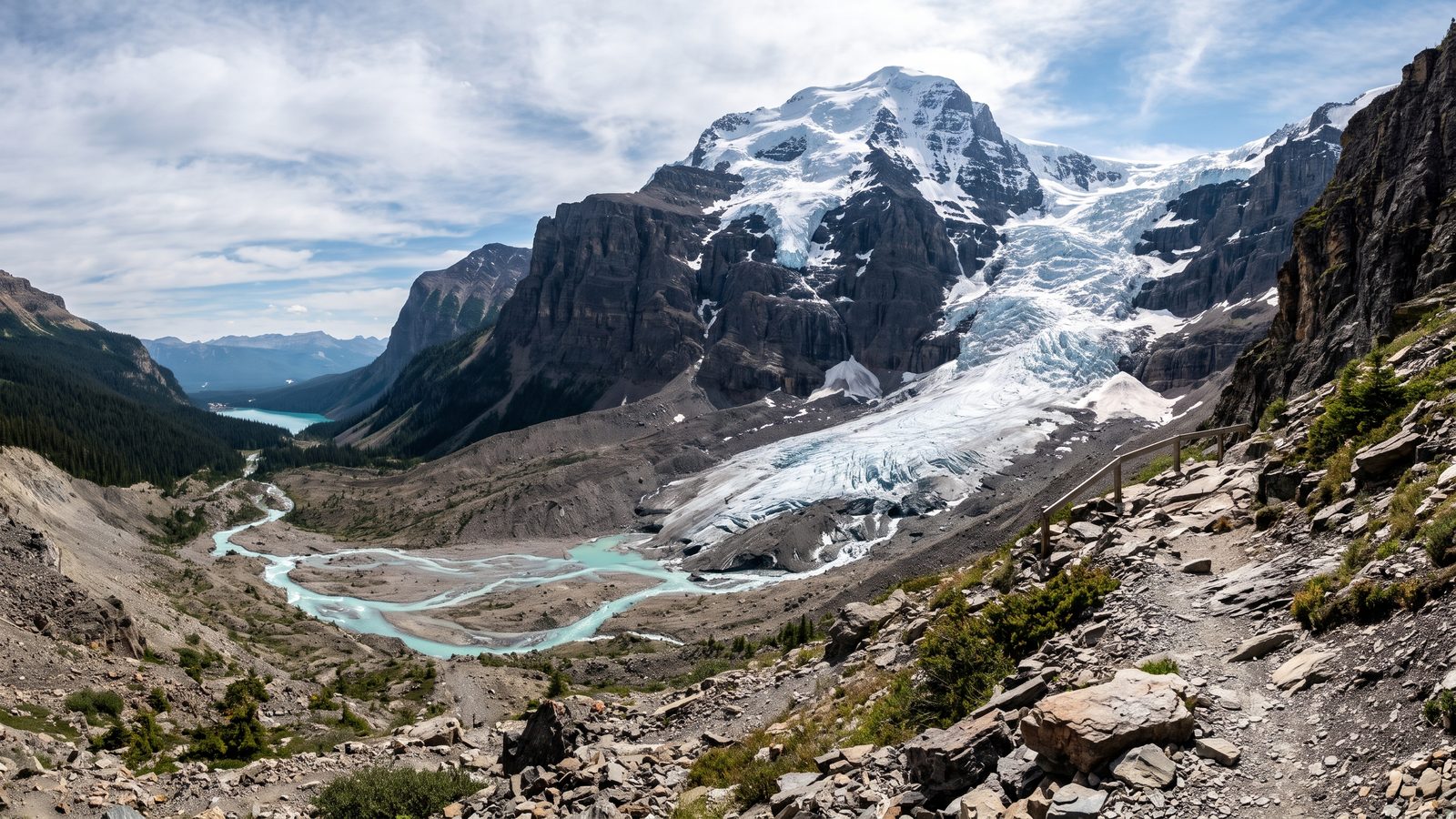
Welcome to the Plain of Six Glaciers Trail audio tour, an immersive journey above Lake Louise into the heart of Banff National Park's grandest peaks. As you ascend past whispering subalpine forests onto high glacial moraines, you walk in the footsteps of early mountaineers and Indigenous travelers. This self-guided trek invites you to marvel at towering icefields, ancient rock formations, and the historic 1924 teahouse nestled beneath Mount Victoria.
Experience the power of dynamic nature, where creaking glaciers grind stone into vibrant turquoise waters. With step-by-step commentary, you will discover resilient wildlife, vernacular architecture, and unmatched panoramic vistas as you forge your own connection to this untamed Canadian wilderness.
What you'll hear on this tour
Stop 1. Surrounded by Ice and Peaks
As you stand here, you are immersed in a living canvas of geological artistry. The sheer scale of Mount Lefroy and Mount Victoria dominates your vision, their jagged, ice-clad summits piercing the sky. Notice how Lower Victoria Glacier directly ahead shimmers with ethereal blues and greens where the ice is densest, reflecting its immense age and compression. You can trace the definitive U-shaped valley, a colossal signature carved by ancient ice rivers over millennia. The stark contrast between vibrant turquoise meltwater streams snaking through grey moraines and dark rock faces creates a dynamic display of constant erosion and renewal, showing you a landscape perpetually being born and reborn.
Stop 2. Life on the Glacial Edge
Feel the profound geological forces actively shaping this landscape. The glaciers you gaze upon continuously grind bedrock into fine "rock flour," giving meltwater its milky hue before feeding turquoise lakes below. Look down at the remarkable tenacity of alpine flora, like purple saxifrage and moss campion, anchored in thin moraine soil during their brief growing season. Keep your eyes peeled for the elusive pika, a small lagomorph camouflaged among the scree while harvesting plants for winter haypiles. You might also spot robust mountain marmots sunning on rocks, their sharp whistles echoing across open terrain as a testament to life's resilience in this extreme high-altitude environment.
Stop 3. Resilience in Timber and Stone
As you approach the Plain of Six Glaciers Tea House, shift your focus to the remarkable human ingenuity embedded in its design. This functional structure features hand-hewn timber beams and a sturdy stone foundation, built to withstand relentless alpine winds and heavy snowfalls. Imagine the incredible challenge of transporting lumber and glass up this rugged terrain by packhorse in the early 20th century. The low profile, thick walls, and small, deeply set windows minimize exposure while maximizing warmth inside. It stands before you as a humble yet powerful example of vernacular architecture, perfectly adapted to extreme mountain conditions as a beacon of human presence forged from wilderness.
Stop 4. Footsteps of Pioneers and Guides
Long before European explorers arrived, Indigenous peoples like the Stoney Nakoda traversed these valleys, understanding their spiritual power for millennia. Non-Indigenous exploration began in the late 19th century as mappers like Walter Wilcox and Samuel Allen charted these peaks. Pioneering Swiss guides like Christian Häsler soon led challenging first ascents up Mount Victoria, testing human endurance against formidable ice walls. The Canadian Pacific Railway developed this very trail to bring tourists deep into the Rockies. Nearby, the historic Plain of Six Glaciers Tea House, built in 1924, continues a century-old tradition of welcoming weary travelers and offering vital refuge in this remote alpine landscape.
Stop 5. Secrets of the Subalpine Canopy
As you walk deeper into the trail, cool air carries the crisp scent of ancient conifers. You are enveloped by a resilient subalpine forest dominated by Engelmann Spruce and Subalpine Fir. Their downward-sweeping branches shed heavy snow and protect delicate undergrowth. Higher up near the treeline, you see gnarled krummholz formations where relentless winds carve trees into low-lying survivalists. This canopy acts as a vital snow reservoir, feeding meltwater streams that supply Lake Louise. Listen closely for the subtle creak of old-growth timber that has stood for centuries. Beneath your feet, mosses, lichens, and fallen logs slowly recycle nutrients into the rocky soil.
Stop 6. Earning the Alpine View
Every step you take on this trail is an active engagement with the wild. You participate directly in the enduring legacy of mountain exploration. Think of the early mountaineers tackling Mount Victoria's icefields with rudimentary gear as you feel the satisfying burn in your muscles during this steady ascent. Each switchback brings a small victory that connects you to intrepid pioneers. Your reward is more than just panoramic scenery; it is a profound sense of personal accomplishment as you navigate the rocky path. Reaching the historic teahouse nestled amidst rugged peaks transforms your challenging hike into a personal triumph in this magnificent Canadian wilderness.
Planning your visit
- Best time to go
- Summer to early autumn (July through September) when the high-alpine trail is free of heavy snowpack. Start early in the morning to secure parking at Lake Louise.
- Approximate duration
- About 4 to 5 hours
- Where to start
- Lake Louise shoreline trail, starting near the Fairmont Chateau Lake Louise and heading toward the back of the lake.
Access and conditions change seasonally — check the official site before you go.
Frequently asked questions
Is Plain of Six Glaciers Trail worth visiting?
Yes, it is widely considered one of the most magnificent hikes in Banff National Park. It combines scenic forest trails, dramatic views of towering glaciers and Mount Victoria, abundant wildlife, and a visit to a historic 1924 alpine tea house.
How long do you need at Plain of Six Glaciers Trail?
You should allow about 4 to 5 hours round-trip for the full hike, giving you plenty of time to navigate the steady elevation gain, take photos, and rest at the historic tea house.
What is the history of the Plain of Six Glaciers Tea House?
Constructed in 1924 by the Canadian Pacific Railway, the tea house was built to provide refuge and warm hospitality to early 20th-century hikers and mountaineers exploring the remote glacial valleys around Lake Louise.
Keep exploring
Header image is an AI-generated illustration of Plain of Six Glaciers Trail. AllTours.ai is an AI audio tour guide — point your camera at any landmark and hear its story.