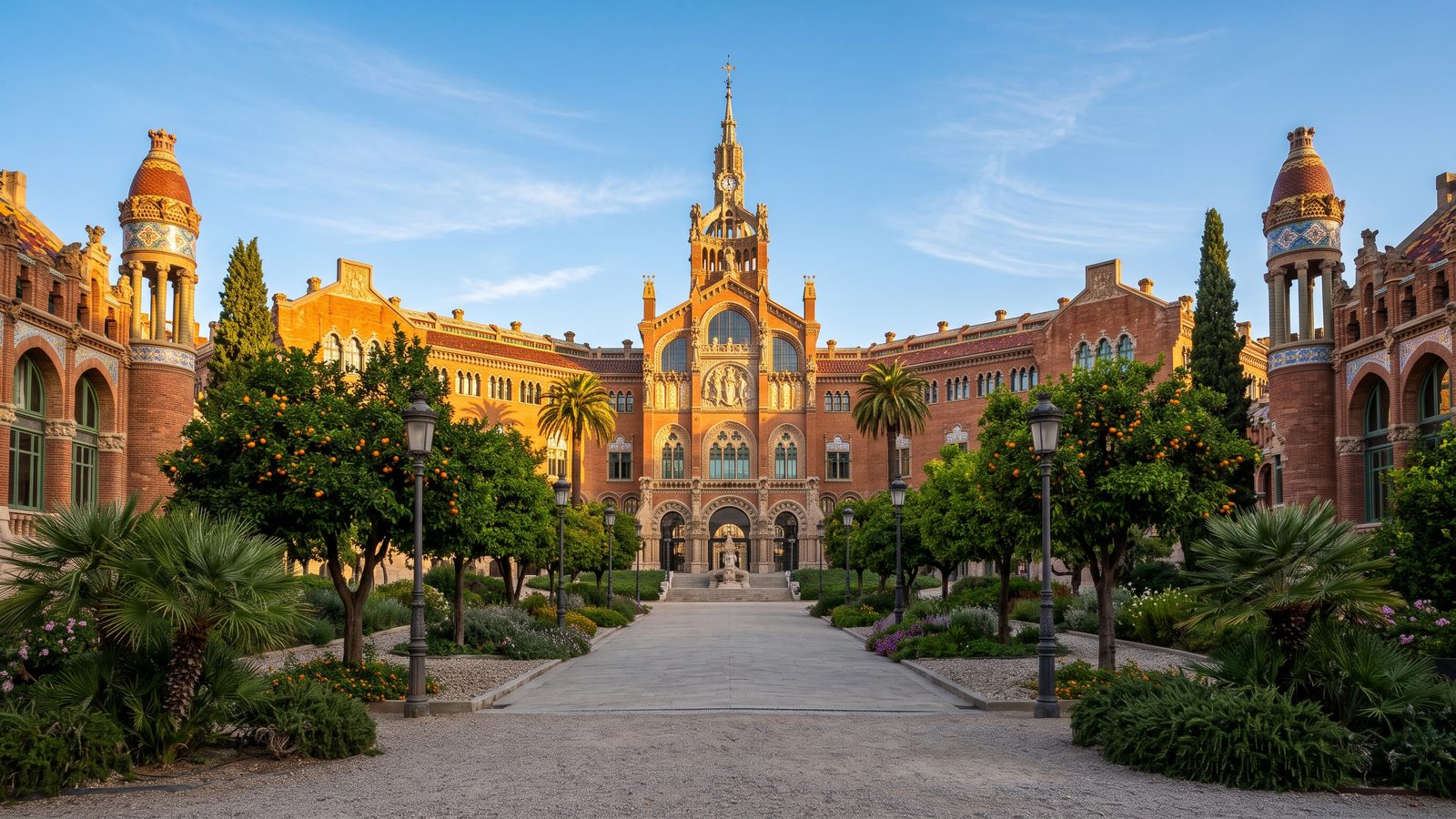
Welcome to the Sant Pau Art Nouveau Site, a magnificent UNESCO World Heritage complex in Barcelona designed by visionary architect Lluís Domènech i Montaner. Built to replace the outdated medieval Hospital de la Santa Creu, this landmark operated as a working public hospital for nearly eight decades. As you walk through its sun-drenched gardens and art-filled pavilions, you will discover a revolutionary design where beauty, light, and fresh air actively aided patient recovery.
This self-guided audio tour leads you through the history, architecture, and subterranean passages of Sant Pau. Learn how Catalan Modernisme transformed medical care into a sanctuary of hope, where intricate ceramic mosaics, stained glass, and therapeutic landscapes came together to uplift the human spirit.
Listen to a sample
The opening of this tour, exactly as AllTours narrates it on site.
What you'll hear on this tour
Stop 1. Mastery of Brick and Ceramic Tile
As you step outside, look closely at the striking facades around you. Architect Lluís Domènech i Montaner masterfully employs polychromatic brickwork, crafting floral and geometric patterns in traditional Catalan obra vista. Notice the dazzling glazed ceramic tiles covering the walls; chosen for their vibrant aesthetic, they also served crucial antiseptic properties in the original hospital. High above, magnificent domes crowned with shimmering mosaics funnel natural light into the spaces below. The entire site functions as an art-filled sanctuary composed of distinct pavilions. As you explore, remember that every single building is seamlessly connected beneath your feet by an ingenious network of underground tunnels.
Stop 2. Stained Glass and Trencadís Mosaics
You are surrounded by a complete Art Nouveau visual world where every surface tells a story. Look at the vibrant trencadís mosaics crafted from carefully placed ceramic shards; they portray allegories of healing, patron saints, and Barcelona’s municipal coats of arms. Overhead, exquisite stained-glass windows—particularly inside the former operating theaters—transform harsh sunlight into rich, jewel-toned colors. Delicate relief sculptures decorate the entrance halls, ranging from protective angels to figures commemorating medical progress. Even the wrought iron accents curve into organic, leafy forms. Every detail here demonstrates how traditional craftsmanship and fine art joined forces to craft an environment that nurtures patient recovery.
Stop 3. From Medieval Roots to Modern Care
You stand on ground created to solve a major public health crisis in 19th-century Barcelona. The old medieval Hospital de la Santa Creu had grown tragically overcrowded and unsanitary. Relief arrived through the legacy of banker Pau Gil, who left funds to build a revolutionary modern hospital named after Saint Paul. Entrusted with the grand vision in 1901, Domènech i Montaner designed a city within a city dedicated to patient well-being. Construction began in 1902, and following the architect's death, his son Pere completed the project. Inaugurated in 1930, this complex served as a vital public hospital until 2009 before undergoing careful restoration.
Stop 4. A Revolutionary Healing Concept
As you walk through these serene corridors, imagine what this complex felt like as an operational hospital. Domènech i Montaner departed from dark, monolithic medical institutions by separating specialties into isolated pavilion blocks. This groundbreaking layout minimized the risk of cross-infection while allowing every patient room to maximize sunlight and fresh air. Doctors and nurses moved efficiently between departments using subterranean tunnels, leaving the sunlit exterior ground quiet and peaceful for recovering patients. By prioritizing fresh air, sunlight, and dignity, Sant Pau transformed the very definition of medical architecture, setting a worldwide standard for modern healthcare facilities for nearly a century.
Stop 5. Therapeutic Landscapes and Mediterranean Flora
Step into the expansive outdoor gardens framing the pavilions. Domènech i Montaner designed these green spaces not merely for decoration, but as active medical tools vital for recovery. As you walk along the graceful pathways, you see how foliage frames the brilliant Art Nouveau architecture. Carefully curated Mediterranean plants offer shade, fragrance, and color throughout every season. Patients once sat on these very benches to breathe fresh air and escape the stress of illness. The open air and natural light were considered just as crucial to healing as surgical or medical treatments, creating a peaceful oasis right in the heart of Barcelona.
Stop 6. The Pure Spirit of Catalan Modernisme
Look at the flowing, organic lines that define every archway and column around you. You are witnessing Catalan Modernisme, a cultural movement championed by Domènech i Montaner that rejected industrial monotony in favor of handcrafted beauty. Notice the natural motifs blooming across mosaics, iron railings, and tiled ceilings. Master artisans utilized traditional building techniques to ensure that art and function remained inseparable. By filling a public medical center with uplifting color, symbolic light, and delicate craft, the architect created a living manifesto of Modernisme—proving that aesthetic beauty could play an active, vital role in restoring the human spirit.
Planning your visit
- Best time to go
- Morning or early afternoon for optimal natural light filtering through the stained glass windows and tiled domes.
- Approximate duration
- about 1.5 hours
- Where to start
- Main entrance portal on Carrer de Sant Antoni Maria Claret.
Access and conditions change seasonally — check the official site before you go.
Frequently asked questions
Is Sant Pau Art Nouveau Site worth visiting?
Yes, Sant Pau Art Nouveau Site is a UNESCO World Heritage landmark and the world's largest Art Nouveau complex. Designed by Lluís Domènech i Montaner, it offers stunning architecture, mosaic-covered pavilions, and tranquil gardens with far fewer crowds than other Barcelona attractions.
How long do you need at Sant Pau Art Nouveau Site?
Most visitors spend between 1 and 2 hours touring the open pavilions, underground tunnels, and therapeutic outdoor gardens.
What is the history behind Sant Pau Art Nouveau Site?
Commissioned in 1901 to replace Barcelona's 15th-century hospital, the complex was funded by banker Pau Gil and designed by Lluís Domènech i Montaner. It served as a working hospital from 1930 to 2009 before being restored as a cultural landmark.
Keep exploring
Header image is an AI-generated illustration of Sant Pau Art Nouveau Site. AllTours.ai is an AI audio tour guide — point your camera at any landmark and hear its story.