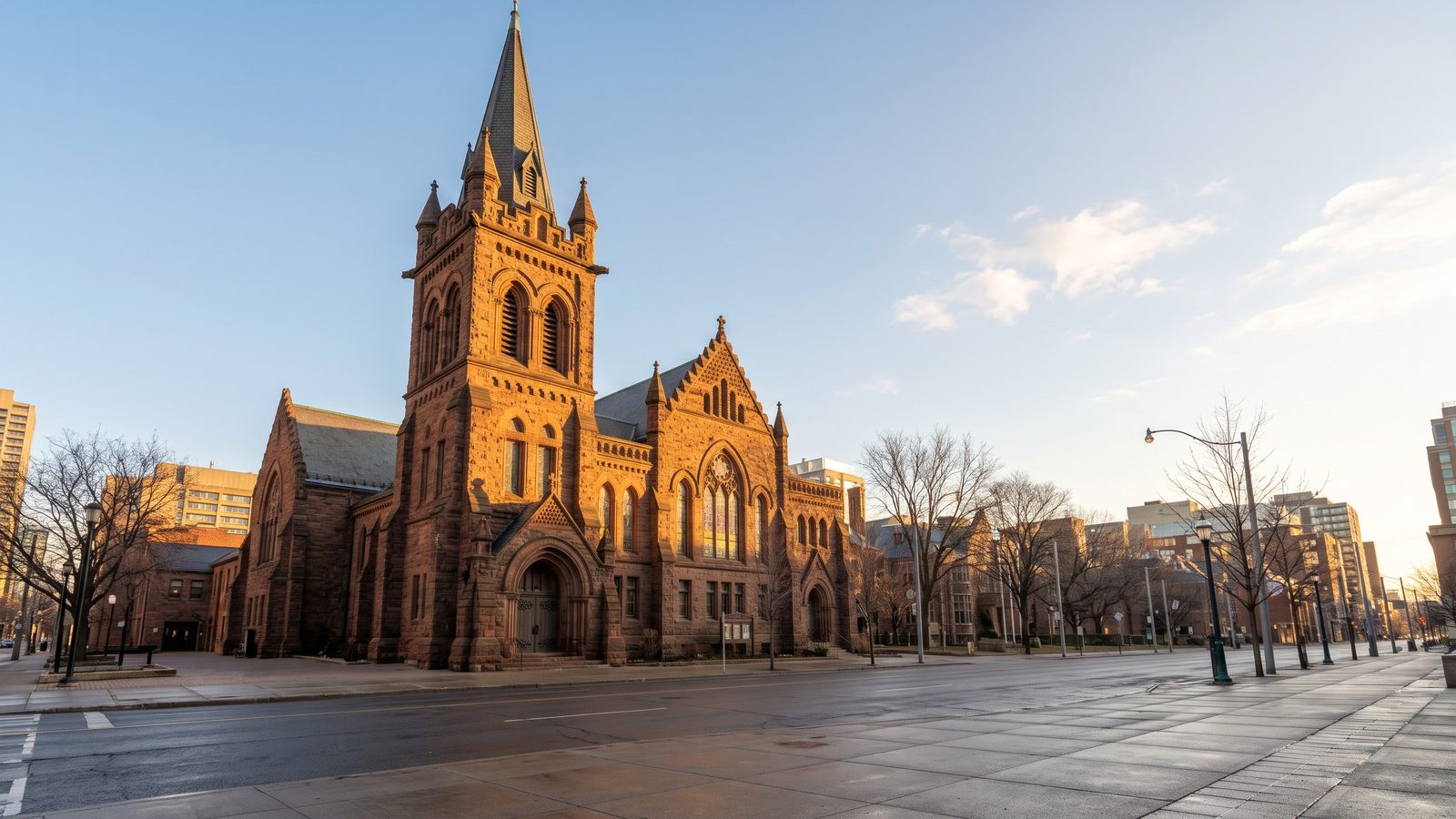
Welcome to St. Andrew's Presbyterian Church, an architectural and spiritual landmark standing proudly at King Street West and Simcoe Street in downtown Toronto. Founded by Scottish immigrants in 1830, this enduring sanctuary blends High Victorian Gothic elegance with Scottish Baronial touches. As you explore its historic facade and timber-roofed interior, you will discover a story of immigrant resilience, deep faith, and vibrant community support stretching across nearly two centuries.
This self-guided audio tour walks you around the church's exterior and light-filled sanctuary. You will trace its journey from pioneer roots on Church Street to its present home amidst the soaring towers of Toronto's financial district, exploring how tradition and community continue to thrive in the urban core.
What you'll hear on this tour
Stop 1. From Pioneer Roots to King Street
Cast your mind back to 1830 when Scottish immigrants in early York founded St. Andrew's. You trace a story that begins with a modest 1831 church on Church Street before navigating the turbulent 1843 Disruption of the Church of Scotland, which aligns the congregation with the Free Church of Scotland. As Toronto rapidly grows, you see the clear need for a grander central sanctuary. In 1874, the cornerstone for this magnificent edifice is laid at King Street West under architect William George Storm. The church officially opens its doors in 1876, standing as a resilient beacon of faith, community, and evolving urban identity through over a century of city change.
Stop 2. High Victorian Gothic Masterpiece
You stand before the commanding High Victorian Gothic Revival facade of St. Andrew's, crafted from warm Credit Valley sandstone shaped by skilled masons. Notice the intricate stone tracery within the lancet windows, guiding your eye upward toward the heavens. Above you, the soaring central tower and spire draw your gaze with carved finials and crocket ornamentation. Inside the nave, you look up to admire a magnificent timber hammer-beam roof spanning the space without intermediate supports. Designed by architect W.G. Storm, this impressive interior skillfully balances Scottish Presbyterian austerity with dramatic Victorian Gothic flair, creating an unobstructed volume rich in textural interplay, buttresses, and structural grandeur.
Stop 3. Defensive Scottish Baronial Touches
Gazing at the formidable stone exterior, you notice distinctive Scottish Baronial Revival details reminiscent of ancient fortified castles. The early Scottish Presbyterian congregation chose this style as a deliberate echo of their homeland's architecture, symbolizing resilience and unwavering faith in Upper Canada. As you examine the facade, observe the robust, rough-hewn ashlar masonry, stepped gables, and corner turrets topped with conical roofs. These direct visual references to historic Scottish defensive structures bring ancestral pride across the Atlantic. This striking stonework connects past and present, offering a tangible link to Scotland's rich architectural heritage right in the heart of modern Toronto.
Stop 4. A Vital Immigrant Lifeline
You discover how this sanctuary served as far more than a place of worship for early Scottish immigrants. Within these walls, a vital social fabric took root, providing housing advice, employment support, and mutual aid during hard times. Benevolent organizations like the St. Andrew's Society actively cared for the sick, widowed, and orphaned. You learn how congregants preserved their cultural identity through ceilidhs, educational evenings, Gaelic language study, and traditional music. Today, as you explore the space, you see how generations of shared memory continue through outreach programs and diverse urban gatherings, maintaining an enduring legacy of communal care and mutual support.
Stop 5. Sanctuary Amid Financial Towers
Stepping onto Simcoe Street, you immediately grasp the dramatic contrast between St. Andrew's historic stone walls and the glass skyscrapers of Toronto's financial district. You stand where modest commercial blocks once gave way to the bustling heart of Canadian banking. Nearby, iconic towers like First Canadian Place and the TD Centre soar overhead, while the fast-paced energy of Bay Street pulses just moments away. Imagining early congregants navigating horse-drawn carriages to worship, you feel the church's steadfast presence amid constant urban progress. Within this historic refuge, you encounter an enduring spiritual and community anchor standing quietly at the center of a dynamic city.
Stop 6. The Pulpit and the Preached Word
Inside the sanctuary, you enter a spiritual setting shaped by the Reformed tradition of Scottish Presbyterianism. Notice the prominent central placement of the pulpit, signifying the preached sermon as the direct focal point of divine truth and Calvinist worship. Here, scripture and the sovereignty of God guide congregational life. You see how personal faith translated directly into civic responsibility, as early members organized charitable initiatives that addressed social justice in the burgeoning city of Toronto. As you look across the pews, you appreciate how generations gathered here to combine rigorous theological discussion with practical community uplift, forging a resilient spiritual legacy.
Planning your visit
- Best time to go
- Weekdays or Saturdays during morning or early afternoon daylight for clear view of sandstone details.
- Approximate duration
- about 30 to 45 minutes
- Where to start
- Outside the main entrance near the intersection of King Street West and Simcoe Street.
Access and conditions change seasonally — check the official site before you go.
Frequently asked questions
Is St. Andrew's Presbyterian Church worth visiting?
Yes, St. Andrew's Presbyterian Church is well worth visiting for anyone interested in Toronto's history, architecture, and Scottish heritage. Designed by architect William George Storm, the building features striking High Victorian Gothic and Scottish Baronial architecture, Credit Valley sandstone, lancet windows, and a magnificent interior hammer-beam roof.
How long do you need at St. Andrew's Presbyterian Church?
A self-guided tour of St. Andrew's Presbyterian Church typically takes 30 to 45 minutes. This allows sufficient time to take in the exterior stonework, central tower, stepped gables, and interior sanctuary highlights.
What is the history of St. Andrew's Presbyterian Church in Toronto?
St. Andrew's was established in 1830 by Scottish immigrants in York, opening its first building on Church Street in 1831. Following the 1843 Disruption of the Church of Scotland, the congregation joined the Free Church of Scotland. Architect William George Storm designed the present sanctuary at King Street West, where the cornerstone was laid in 1874 and the church officially opened in 1876.
Keep exploring
Header image is an AI-generated illustration of St. Andrew's Presbyterian Church. AllTours.ai is an AI audio tour guide — point your camera at any landmark and hear its story.