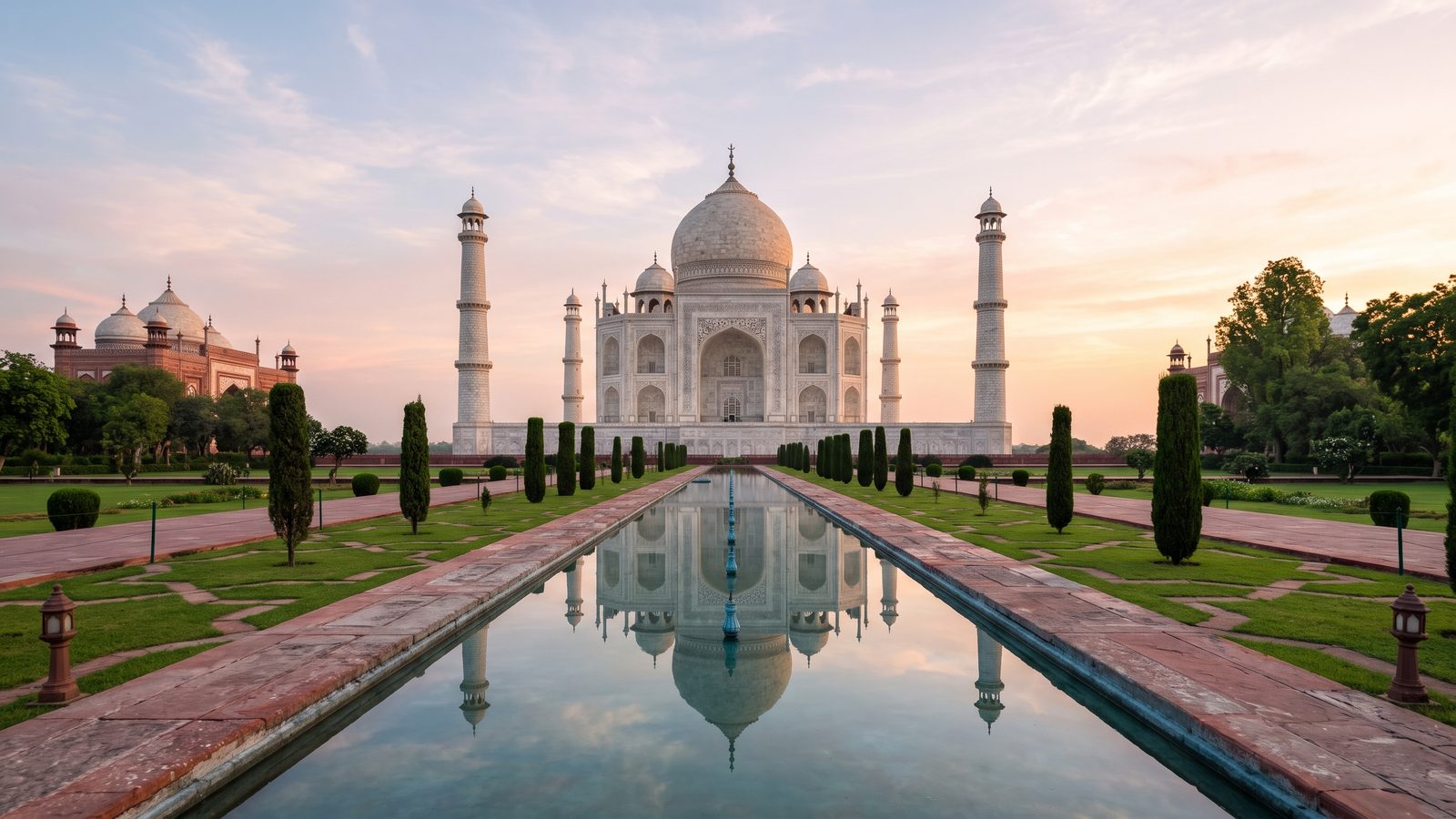
You stand before the magnificent Taj Mahal in Agra, a UNESCO World Heritage site recognized worldwide as the ultimate monument to eternal love. Commissioned in the 17th century by Mughal Emperor Shah Jahan in memory of his beloved wife, Mumtaz Mahal, this pristine white marble mausoleum harmoniously fuses Persian, Islamic, and Indian architectural traditions into a breathtaking whole. Every intricate detail tells a story of grief, devotion, and extraordinary craftsmanship.
With this self-guided audio tour, you walk through the serene Charbagh gardens, marvel at perfect bilateral symmetry, and discover the secrets behind translucent Makrana marble and fine pietra dura inlay. Step back in time to experience India's grandest architectural masterpiece at your own rhythm.
Listen to a sample
The opening of this tour, exactly as AllTours narrates it on site.
What you'll hear on this tour
Stop 1. An Imperial Monument Born of Grief
You step into a history rooted in profound imperial sorrow. Construction begins in 1631 after Emperor Shah Jahan suffers the devastating loss of his beloved wife, Mumtaz Mahal, during the birth of their fourteenth child in Burhanpur. Overcome by grief, the emperor vows to erect an unparalleled mausoleum to honor their eternal love. For over two decades, master architect Ustad Ahmed Lahori leads an army of 20,000 craftsmen, artisans, and laborers. Elephants and oxen transport pristine white Makrana marble from Rajasthan, completing the grand monument around 1653 as a timeless testament to romantic devotion.
Stop 2. Symmetry, Marble, and Engineering Marvels
As you examine the main structure, the architectural brilliance of Mughal design unfolds before you. Notice the perfect bilateral symmetry expressing balance and harmony. Four minarets over 40 meters high tilt subtly outward, a clever engineering safeguard designed to fall away from the tomb during an earthquake. High above, the central onion dome features a lotus motif, integrating traditional Hindu symbols with Islamic art. Translucent Makrana marble shifts shades with changing light, glowing soft pink at dawn and golden at sunset. Looking closer, thousands of semi-precious stones form delicate floral patterns inside the precise pietra dura inlay work across cold stone.
Stop 3. The Charbagh Paradise on Earth
You walk through the grand gate into the Charbagh, a Persian-inspired four-part garden representing Paradise on Earth. Four flowing water channels, lined with cypress trees, symbolize the four rivers of Jannah mentioned in the Quran. These pathways split the landscape into harmonious quadrants, establishing strict order and balance. In the center, a raised marble lotus pool reflects the mausoleum like a mirror, doubling its ethereal presence. As you walk pathways where Emperor Shah Jahan once sought solace, every fountain and carefully positioned tree transforms your stroll into a tranquil prelude to the grand monument of love.
Stop 4. Capturing the Translucent Masterpiece
You discover that the Taj Mahal offers a photographer's dream, with shifting natural light constantly altering the marble's colors. Early morning and late afternoon light turn the monument soft pink and fiery orange. You can stand near the famous Diana Bench to frame the iconic central dome perfectly behind you. Looking down the long reflective pools on a calm morning reveals brilliant mirror images painted across the water. For fresh angles, explore the flanking mosques to capture the structure's strict symmetry and outward-tilted minarets. Patience allows crowd-free moments to photograph intricate pietra dura details up close.
Stop 5. A Living Symbol of Indian Identity
You absorb a cultural touchstone that extends far beyond physical stone into the heart of Indian consciousness. This monument serves as an enduring symbol of reverence for love and beauty, inspiring centuries of classical poetry, folk music, and romantic Indian cinema. The legacy of Mughal craftsmanship continues living today in Agra, where modern artisans preserve centuries-old pietra dura inlay techniques handed down through generations. As you experience this sacred landscape, you feel how seamlessly art and emotion interweave, reflecting a national identity steeped in pride, devotion, and creative perfection that resonates deeply with visitors from around the globe.
Stop 6. Safeguarding a World Heritage Treasure
You stand before a globally celebrated masterpiece of human creative genius, recognized as a UNESCO World Heritage Site since 1983. The monument represents the absolute zenith of Mughal architectural heritage by synthesizing Persian, Islamic, and Indian artistic traditions into one harmonious form. Masterful skills in marble carving, calligraphy, and pietra dura inlay represent an irreplaceable living heritage preserved across centuries. Around you, meticulous ongoing restoration efforts safeguard this artistic legacy for future generations. As you explore, you participate in honoring a global inheritance—a timeless testament to human artistry, architectural genius, and eternal love that continues to inspire the world.
Planning your visit
- Best time to go
- Early morning at sunrise or late afternoon near sunset for soft light and cooler temperatures.
- Approximate duration
- About 2 to 3 hours
- Where to start
- Main entrance forecourt before entering the Charbagh garden gate.
Access and conditions change seasonally — check the official site before you go.
Frequently asked questions
Is Taj Mahal worth visiting?
Yes. As a UNESCO World Heritage Site and the pinnacle of Mughal architecture, its extraordinary marble craftsmanship, symmetrical design, and history make it one of the world's premier destinations.
How long do you need at Taj Mahal?
Most visitors need about 2 to 3 hours to explore the central mausoleum, walk through the Charbagh gardens, admire the pietra dura inlay work, and take photographs.
Why was the Taj Mahal built?
Mughal Emperor Shah Jahan commissioned the Taj Mahal in 1631 as a tomb and memorial for his beloved wife, Mumtaz Mahal, who died during childbirth.
Keep exploring
Header image is an AI-generated illustration of Taj Mahal. AllTours.ai is an AI audio tour guide — point your camera at any landmark and hear its story.