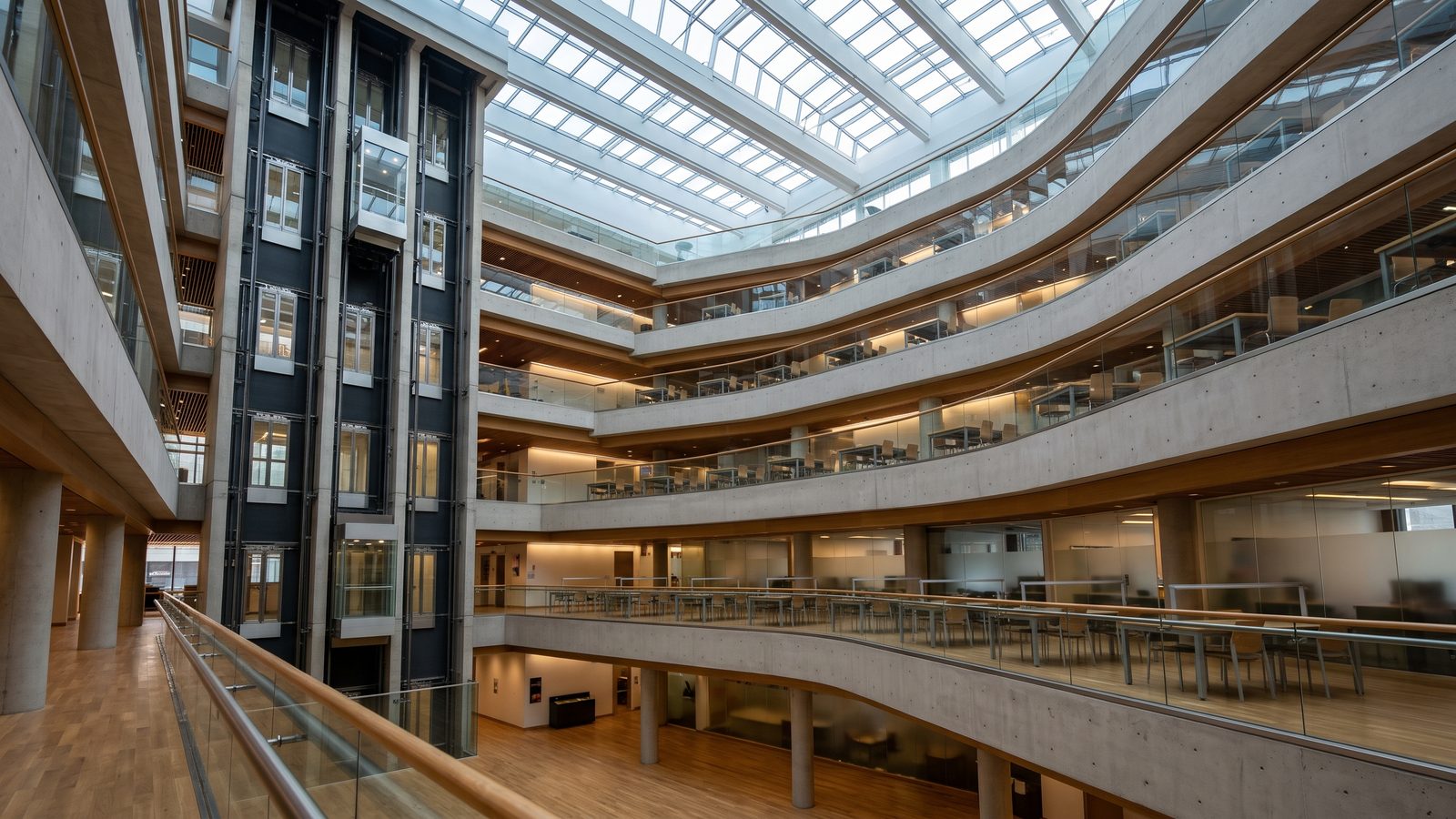
Welcome to the Toronto Reference Library, a landmark of modernist public design located in Toronto, Ontario. Envisioned by architect Raymond Moriyama as a cathedral of light and learning, this soaring atrium seamlessly unites vast collections, vibrant community spaces, and serene study areas. As you step inside, prepare to experience a public square for the mind where history, creativity, and modern innovation meet across terraced reading levels.
With this self-guided audio tour, you will navigate the building's iconic architectural features, discover rare historical collections, admire monumental artworks, and explore dynamic spaces dedicated to public learning and research. Take your time wandering through each level as you absorb the stories behind Canada's premier public reference library.
What you'll hear on this tour
Stop 1. Raymond Moriyama's Cathedral of Light
You step into a colossal central atrium, a postmodern masterpiece designed by architect Raymond Moriyama. As you look up, light pours through massive skylights, bathing terraced reading levels that cascade around you like gentle waterfalls. You watch iconic glass elevators glide silently along the walls as moving sculptures, offering dynamic perspectives of the vast interior volume. Moriyama deliberately softened traditional library boundaries, employing smooth curves, warm wood accents, and concrete to create a welcoming public square for the mind. Notice how the fluid layout invites discovery, turning a massive storage of knowledge into a light-filled urban room crafted for continuous exploration and community connection.
Stop 2. Rare Treasures and Living Legacies
You stand surrounded by millions of preserved volumes, each carrying a unique legacy. As you explore the specialized collections, you encounter the Merril Collection of Science Fiction, Fantasy and Horror, tracing genre history through rare early twentieth-century first editions and pulp magazines. Nearby, you discover the Baldwin Collection of Canadiana, a national treasure trove filled with original maps, historical pamphlets, and early printed books chronicling Canada's past. You imagine touching delicate pages turned by readers centuries ago, feeling a direct link to the minds that shaped human understanding. Every spine on these shelves represents a voice carefully protected for future generations to awaken.
Stop 3. Monuments of Memory and Reflection
As you walk across the north wall, your eyes focus on Derek Michael Besant's vast multi-panel mural, 'Passages.' You observe sepia-toned, dreamlike imagery where fragmented faces emerge from blurred landscapes, symbolizing the elusive flow of memory and human knowledge. On the main floor, you encounter Derek Charke's bronze sculpture, 'The Reader,' whose calm posture invites quiet contemplation amidst the surrounding hum of activity. Across various floors, dedicated gallery spaces continuously host changing exhibitions of local and international artists. You realize that artwork here is not decorative filler, but a fundamental conversation between past traditions and contemporary creative expression.
Stop 4. A Vibrant Public Square of Ideas
You experience the library as an active cultural nexus where Toronto’s diverse communities gather. Moving beyond traditional quiet study, you discover living archives that showcase everything from mid-twentieth-century pulp fiction cover art to rare fashion plates reflecting historical trends. Around you, public spaces transform into stages for author readings, panel discussions, and artistic performances that ignite civic dialogue. You see how the open atrium welcomes continuous cultural programming, inviting everyday visitors to share stories and artistic passions. This building acts as a dynamic civic living room, ensuring that diverse perspectives constantly intersect and enrich the city's shared identity.
Stop 5. Interactive Spaces for Hands-On Discovery
You enter a dynamic ecosystem built for practical skill acquisition and creative experimentation. In quiet alcoves, you observe visitors learning new languages through interactive digital tools. Nearby, dedicated media labs offer hands-on opportunities to explore podcast production and 3D printing technology, turning abstract ideas into physical projects. You spot teenagers collaborating on coding challenges beside seniors mastering digital literacy skills, all supported by specialized workshops ranging from graphic design to memoir writing. Here, education transcends traditional books; you are standing in a living lab designed to make technology, creativity, and personal development accessible to every member of the public.
Stop 6. Inside the Engine of Serious Inquiry
You step into hushed research areas where serious inquiry unfolds daily. In climate-controlled archives, specialized collections hold rare historical maps and microform archives of centuries-old newspapers waiting to reveal forgotten stories. You watch expert librarians guide researchers through complex digital databases and obscure indexes, uncovering primary sources that unlock family genealogies or doctoral dissertations. Sitting at a quiet study carrel, you sense the intense focus of scholars connecting disparate facts into new insights. This area serves as a true crucible of discovery, empowering anyone with curiosity to delve into primary documents and contribute to human knowledge.
Planning your visit
- Best time to go
- Weekday mornings or mid-afternoons for quieter spaces and optimal natural light.
- Approximate duration
- about 1 to 1.5 hours
- Where to start
- Ground floor central atrium inside the main entrance.
Access and conditions change seasonally — check the official site before you go.
Frequently asked questions
Is Toronto Reference Library worth visiting?
Yes, the Toronto Reference Library is widely considered worth visiting for its striking postmodern architecture designed by Raymond Moriyama, its vast rare collections, public art installations like Derek Michael Besant's 'Passages', and vibrant cultural atmosphere.
How long do you need at Toronto Reference Library?
Most visitors spend between 1 and 2 hours exploring the public atrium, gallery spaces, special collections such as the Merril and Baldwin collections, and viewing the library's architectural highlights.
Who designed the Toronto Reference Library?
The Toronto Reference Library was designed by acclaimed Canadian architect Raymond Moriyama as a postmodern 'cathedral of light and learning' featuring a soaring skylit central atrium and terraced reading levels.
Keep exploring
Header image is an AI-generated illustration of Toronto Reference Library. AllTours.ai is an AI audio tour guide — point your camera at any landmark and hear its story.