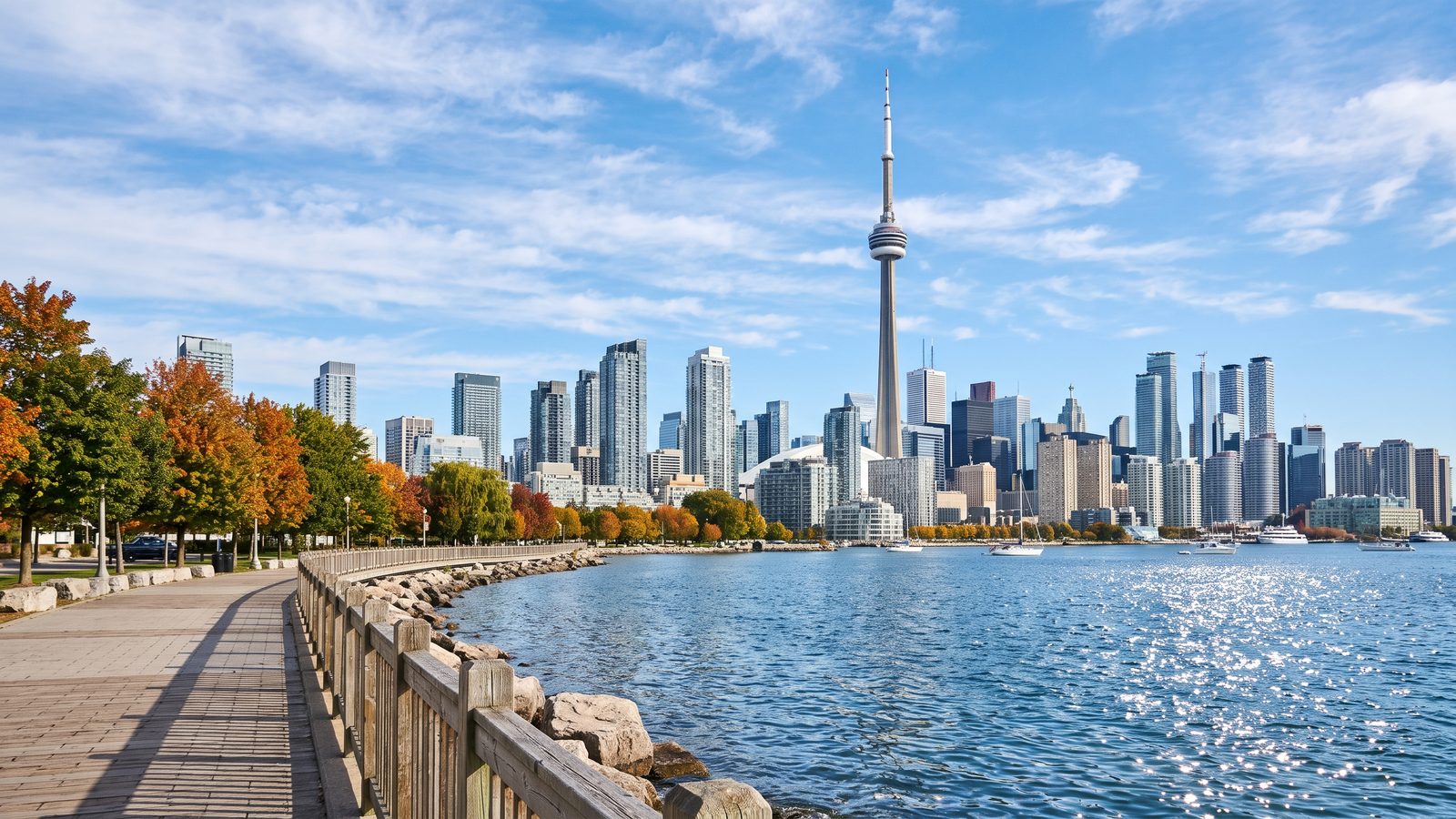
Welcome to Toronto, a bustling metropolis pulsating with art, history, and global cultures. On this self-guided journey, you explore legendary landmarks like the soaring CN Tower and historic hubs like Kensington Market. Uncover a city built on indigenous roots, shaped by historic conflicts, and transformed into a world-class center of commerce, creativity, and community. Prepare to experience an unforgettable urban adventure at your own pace.
Immerse yourself in a dynamic cityscape where historic industrial spaces host contemporary galleries, and streets buzz with international flavors. Hear the compelling stories behind Toronto's architectural triumphs and diverse cultural tapestry as you wander through its vibrant neighborhoods and take in sweeping views of Lake Ontario.
Listen to a sample
The opening of this tour, exactly as AllTours narrates it on site.
What you'll hear on this tour
Stop 1. Engineering Triumph of the CN Tower
You stand before the CN Tower, a masterclass in post-modern engineering completed in 1976 that reaches an astonishing height of 553.33 meters. As you admire its soaring Y-shaped silhouette, notice how this precast concrete lattice provides immense stability against strong winds off Lake Ontario. Look closely at the seven recessed windows along the shaft, marking the locations of reinforced concrete climbing formwork used during construction. Above you, cantilevered observation pods hang dramatically from the main structure. You witness a bold statement of steel and concrete, pushing the boundaries of mid-20th-century design while delivering unobstructed, breathtaking panoramas of the metropolis stretching far below.
Stop 2. Resilience Born from York's Foundations
You walk upon lands shaped by the Toronto Purchase, late 18th and early 19th-century agreements between the Crown and the Mississaugas of the Credit First Nation. As you explore, imagine early 1800s settlers clearing dense wilderness to establish the town of York, a vital military outpost and capital of Upper Canada. The War of 1812 leaves a profound impact when American forces burn York, forging a deep resilience within the young community. Rebuilt with renewed determination, the town officially takes the name Toronto in 1834, marking a crucial leap toward self-governance. Today, you sense this storied foundation underlying every step across the modern urban landscape.
Stop 3. A Global Mosaic of Many Voices
You step into a city where over half the population was born outside Canada, creating an extraordinary cultural mosaic. Around you, shop signs display dozens of languages while the streets fill with infectious energy during world-renowned festivals. You hear melodic accents from every continent and sense an ongoing exchange that redefines what it means to be Torontonian. This vibrant diversity shapes daily life, from Caribbean rhythms at Caribana to Greek celebrations during Taste of the Danforth. As you explore, you taste this global journey through authentic Ethiopian injera or inventive Vietnamese pho, experiencing world cultures harmoniously interwoven into one welcoming metropolis.
Stop 4. Creative Spirit in the Distillery District
You feel the city's artistic soul pulsing through historic industrial spaces like the Distillery District, where 19th-century buildings now house contemporary art studios and galleries. As you wander down cobblestone laneways, vibrant murals cover surrounding walls, turning mundane brickwork into accessible canvases commissioned by local organizations. At the Art Gallery of Ontario, you discover collections spanning centuries, with a dedicated highlight on First Nations creators and emerging Canadian talent. Everywhere you look, Toronto democratizes creative expression. From world-class indoor galleries to expressive alleyway murals, you encounter a thriving cultural hub where historic heritage directly inspires bold visual narratives today.
Stop 5. Global Culinary Journey Across Neighborhoods
You embark on a global culinary adventure without ever leaving the city bounds. Toronto’s food scene directly reflects its rich multicultural heritage, inviting you to sample authentic Hakka cuisine, a unique Indo-Chinese fusion born from migration. Nearby, you smell aromatic spices filling the air around historic temples, leading you to vibrant Indian dining spots. You discover sizzling Korean BBQ that rivals Seoul's finest establishments, alongside a burgeoning Filipino food movement serving savory adobo and sweet halo-halo. Every bite you take tells a compelling story of heritage, adaptation, and community, making this city a premier international destination for passionate food lovers.
Stop 6. Sweeping Panoramas over Lake Ontario
You look outward from high above the streets, taking in Toronto's incredible panorama unfolding before you. Gazing down, you see shimmering glass towers catch the sunlight, crafting an ever-changing mosaic against the sky and Lake Ontario's vast horizon. From this elevated vantage point, you discern the intricate urban layout, where pulsing traffic arteries flow like a grand map below. Imagine how different this vista appeared decades ago before ambitious high-rise development transformed the shoreline. Up here, you do not simply view the cityscape; you comprehend the immense scale, energy, and ongoing architectural dynamism of Canada's largest metropolis.
Planning your visit
- Best time to go
- May to October offers pleasant walking weather; morning or late afternoon provides the best light for skyline views.
- Approximate duration
- About 2 to 3 hours
- Where to start
- Downtown Toronto near the base of the CN Tower or Kensington Market area.
Access and conditions change seasonally — check the official site before you go.
Frequently asked questions
Is Toronto worth visiting?
Yes, Toronto is worth visiting for its iconic architectural landmarks like the CN Tower, world-class multicultural food scene, vibrant arts districts, and rich history along Lake Ontario.
How long do you need at Toronto?
A 2 to 3-day trip lets you experience key attractions like the CN Tower, Distillery District, Kensington Market, diverse global dining, and major art galleries at a comfortable pace.
What was Toronto called before it became a city?
Before taking the name Toronto upon incorporation in 1834, the settlement was established in the early 1800s as the town of York, serving as the capital of Upper Canada.
Keep exploring
Header image is an AI-generated illustration of Toronto. AllTours.ai is an AI audio tour guide — point your camera at any landmark and hear its story.