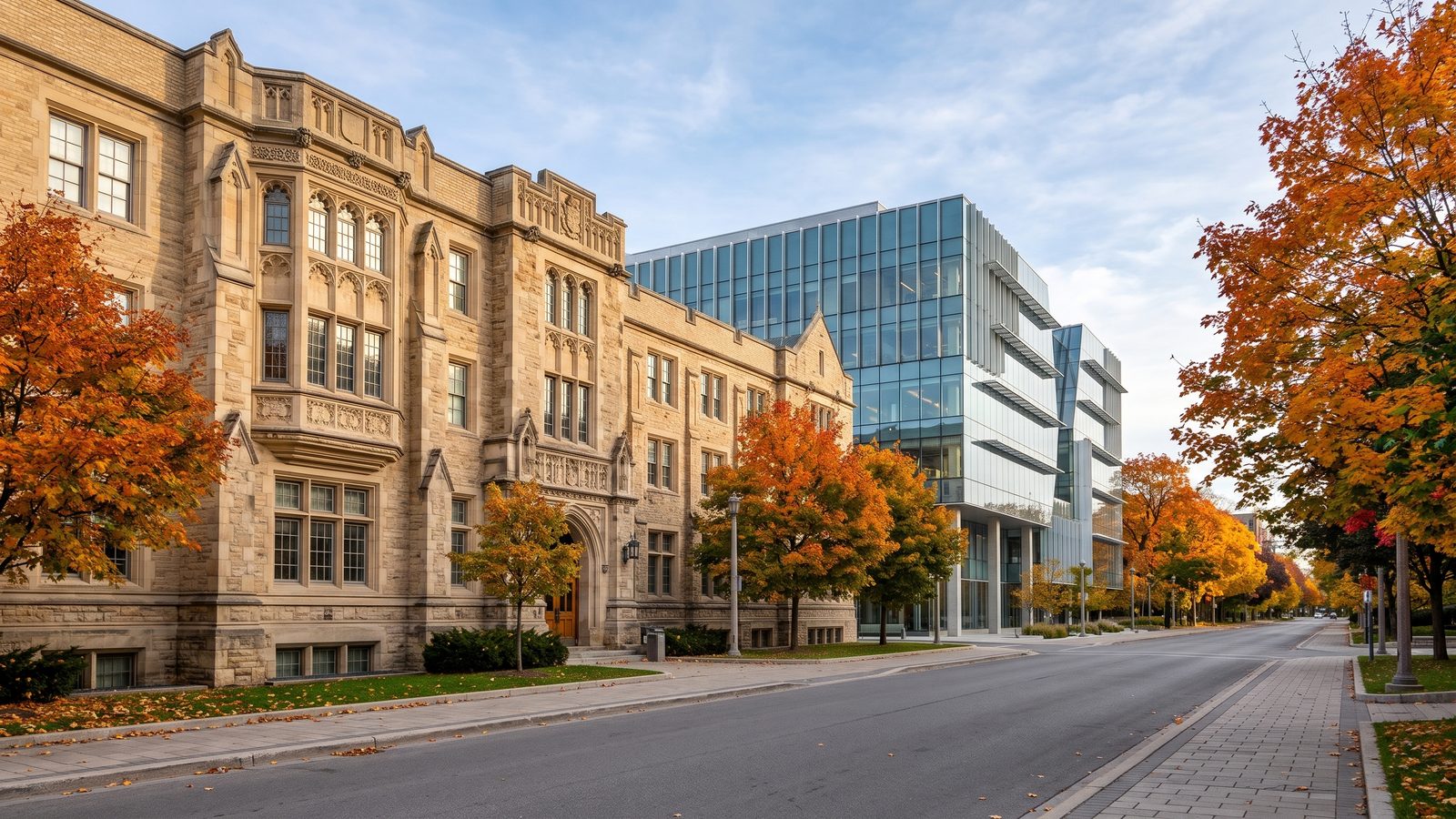
Welcome to the University of Toronto's Faculty of Applied Science & Engineering, affectionately known to its students as 'Skule'. Founded in 1873, this premier engineering precinct blends historic stone architecture with high-tech glass research facilities. As you walk through these halls, you explore the birthplace of North America's first practical electron microscope, pioneer computing projects, and world-shaping artificial intelligence breakthroughs that continue to transform global industry and daily life today.
This self-guided audio tour walks you through the active heart of Canadian innovation. From student design studios to pioneering laboratories in regenerative medicine and robotics, you witness how theoretical knowledge merges seamlessly with real-world impact across this world-class downtown Toronto campus.
Listen to a sample
The opening of this tour, exactly as AllTours narrates it on site.
What you'll hear on this tour
Stop 1. Crucible of Global Tech Breakthroughs
You step into the precinct where engineers fundamentally transform global industries and daily life. As you walk these halls, consider how U of T engineers developed North America's first practical electron microscope in the early twentieth century, forever altering scientific observation. Fast forward, and you stand at the birthplace of deep learning, where researchers laid the groundwork for the modern AI revolution. Look around to feel the legacy of civil engineers who designed Toronto's essential infrastructure, alongside biomedical pioneers crafting life-saving medical devices. From sustainable energy solutions to advanced robotics, you experience a dynamic environment where groundbreaking innovations shape every facet of modern existence.
Stop 2. From Early Computers to Regenerative Medicine
You stand on ground where applied science consistently redefines human capability. Long before modern tech hubs emerged, U of T engineers designed and built UTEC in the 1950s, one of Canada's first electronic computers. You see this drive to translate scientific discovery into practical solutions alive today in spin-off companies, patents, and cutting-edge labs. Pass by facilities dedicated to regenerative medicine, where researchers engineer biomaterials to heal human tissue, or explore sustainable energy initiatives tackling climate change. Surrounding historic buildings and high-tech structures remind you that students and faculty here constantly challenge norms, transforming bold ideas into tangible, world-changing impacts across every discipline.
Stop 3. Architectural Tapestry of Tradition and Technology
As you walk through the engineering precinct, you notice how the physical architecture tells a story of evolving innovation. The stone facade of the venerable Galbraith Building represents early twentieth-century engineering heritage, standing in striking contrast to the transparent glass and steel of the Bahen Centre for Information Technology. You see an interconnected ecosystem crafted for creativity. At the Myhal Centre for Engineering Innovation & Entrepreneurship, open labs serve as incubators for student projects. Nearby, the Sandford Fleming Building honors the pioneer of standard time, reminding you how historic spaces and high-tech studios together foster Canada's next generation of visionary problem-solvers.
Stop 4. Pushing Boundaries in Labs and Robotics
You feel the hum of discovery as you navigate corridors where researchers actively create the future. Every lab door you pass conceals pioneering inquiries, from tissue engineering and quantum computing to smart urban infrastructure and surgical robotics. You witness applied science working in direct collaboration with industry partners, rapidly turning academic breakthroughs into real-world startups and patents. Notice how interdisciplinary synergy drives this work, as engineers collaborate with medical experts, computer scientists, and environmentalists. You walk amidst an intellectual engine that crafts tangible solutions for global challenges, ensuring that innovations emerging from these hallways remain deeply relevant and globally transformative.
Stop 5. Hands-On Learning and Entrepreneurial Spirit
Here, you experience an educational model designed to actively forge solutions rather than just absorb theory. From your very first year, collaborative design projects challenge you to solve real-world problems, such as engineering sustainable water filtration systems or building autonomous robots. You interact with faculty mentors who are leading pioneers in their fields, bringing cutting-edge research straight into modern classrooms and design studios. This project-based learning fosters critical thinking, ethical leadership, and adaptability. As you explore, you see how this hands-on curriculum instills an entrepreneurial mindset, preparing graduates to navigate rapidly changing technological landscapes and shape the future of global engineering.
Stop 6. Heart of Canada's Premier Public Institution
You stand within the intellectual heart of the University of Toronto, an institution traceably rooted in the 1827 establishment of King's College. You observe how its unique federated college system creates intimate academic communities within a world-renowned university. Around you, collegiate gothic architecture evokes historic European traditions while remaining a distinctly Canadian monument to accessible public education. As you explore this vibrant setting, you sense a relentless pursuit of knowledge that spans centuries. You witness a dynamic academic environment where global thought leaders are forged, interdisciplinary research thrives, and foundational ideas continue to push the boundaries of human understanding.
Planning your visit
- Best time to go
- Weekdays during autumn or spring when campus activity is vibrant and light illuminates the buildings.
- Approximate duration
- About 45 to 60 minutes
- Where to start
- Outside the Sandford Fleming Building or the Galbraith Building in the U of T engineering precinct.
Access and conditions change seasonally — check the official site before you go.
Frequently asked questions
Is U of T Faculty of Applied Science & Engineering worth visiting?
Yes, it is a fascinating hub of Canadian innovation featuring a unique mix of historic architecture like the Sandford Fleming Building alongside modern facilities like the Bahen Centre and Myhal Centre.
How long do you need at U of T Faculty of Applied Science & Engineering?
A self-guided walking tour of the engineering precinct typically takes between 45 and 60 minutes to explore the key buildings and exterior spaces.
When was U of T Engineering founded and what are its major historical achievements?
The faculty was founded in 1873 (affectionately known as 'Skule'). Historic breakthroughs include building UTEC (one of Canada's first electronic computers in the 1950s) and developing North America's first practical electron microscope.
Keep exploring
Header image is an AI-generated illustration of U of T Faculty of Applied Science & Engineering. AllTours.ai is an AI audio tour guide — point your camera at any landmark and hear its story.