Step onto the grounds of the University of Toronto Faculty of Law, a cornerstone of Canadian legal education and jurisprudence. Established in 1887, this institution transformed from a daring academic experiment into a powerhouse of legal thought. As you explore the campus, you will witness an extraordinary dialogue between heritage architecture and modern design, reflecting the faculty's rich history and forward-looking commitment to justice, scholarly debate, and public leadership.
Experience where Canada's premier legal minds, including Supreme Court justices and national leaders, honed their craft. This self-guided audio tour guides you through historic halls, light-filled modern spaces, and central courtyards, revealing how legal theory and critical thinking continue to shape the nation's legal landscape.
Listen to a sample
The opening of this tour, exactly as AllTours narrates it on site.
What you'll hear on this tour
Stop 1. A Dialogue of Glass and Sandstone
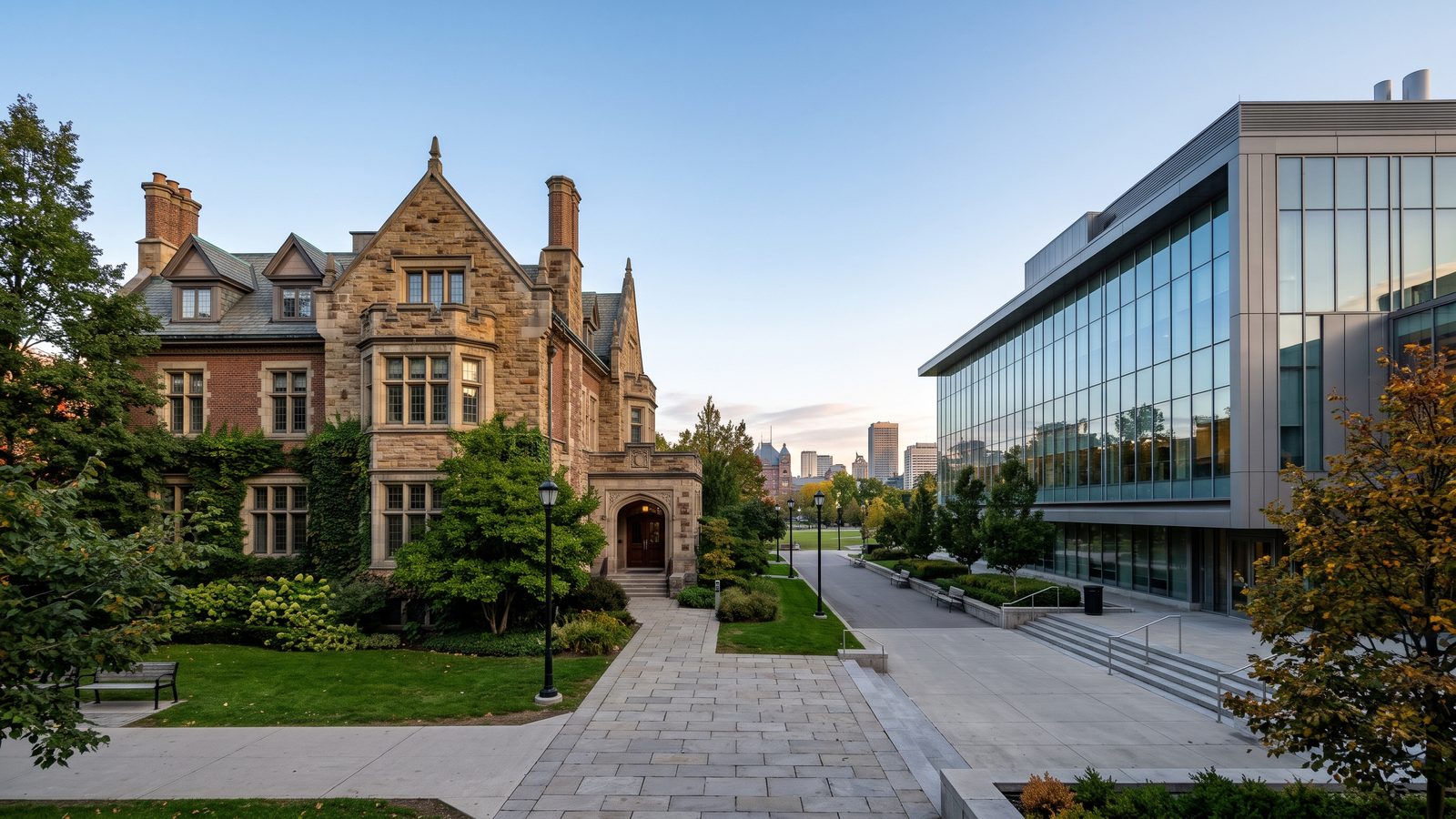
As you look across the campus, you immediately notice a striking architectural dialogue between eras. The venerable Flavelle House anchors the site with its Collegiate Gothic sandstone façade, intricate carvings, and pointed archways that evoke medieval academic traditions. Beside it rises the sleek, crystalline Jackman Law Building, designed by Hariri Pontarini Architects. Its expansive glass curtain walls reflect the adjacent heritage structures, creating a dynamic harmony of transparency and solidity. Sunlight floods through the glass to illuminate warm wood accents and precise steel frameworks, creating an open, collaborative environment. This deliberate contrast honors historical scholarship while boldly celebrating modern innovation.
Stop 2. The Wrightian Revolution in Education
You stand on ground that witnessed a dramatic shift in Canadian education. Originating in 1887 as a Department of Law within University College, the school challenged Ontario's traditional apprenticeship system. For decades, the Law Society of Upper Canada resisted university-based legal training, favoring practical on-the-job experience. That changed in 1949 when the institution officially became the Faculty of Law, driven by Dean Cecil A. Wright. His 'Wrightian Revolution' fundamentally replaced rote learning with a rigorous academic curriculum grounded in theory, philosophy, and history. Here, legal education evolved from a simple trade into a respected scholarly discipline, shaping generations of critical thinkers.
Stop 3. An Academic Village in the City
As you walk through the grounds, you feel a seamless blend of historic tradition and modern vitality. Pathways lead past green spaces that give the campus an intimate, academic village feel right in the middle of Toronto. You can easily navigate between the wood-paneled common rooms of Flavelle House and the state-of-the-art lecture halls inside the Jackman Law Building. At the center, a lively courtyard offers a space for reflection or spirited debate among students. Spanning multiple floors, the Bora Laskin Law Library remains the intellectual heart of the campus, where daylight and focused energy fill vast study collections.
Stop 4. The Art of Legal Argumentation
Inside these seminar rooms, you encounter an intense, hands-on approach to legal training. Rather than listening to passive lectures, students engage in dynamic Socratic dialogues, defending their legal arguments before world-renowned professors. Beyond theoretical coursework, students apply their knowledge directly to real client cases through clinical programs, honing ethical awareness and practical experience. You also see the impact of student-run law journals and competitive moot court events, where future advocates refine courtroom skills in simulated legal battles. This rigorous environment transforms students into analytical thinkers ready to tackle complex constitutional issues and champion justice across the nation.
Stop 5. Crucible of Canadian Jurisprudence
You are standing where some of Canada's most influential legal minds forged their legacy. Former Chief Justice Bora Laskin studied and taught here, helping elevate the faculty into a hub for cutting-edge research in international human rights and constitutional law. In the multi-floor Bora Laskin Law Library, scholars and students dissect complex cases that directly shape public policy and national jurisprudence. Through moot courtrooms and groundbreaking legal scholarship, the faculty actively contributes to the evolution of the legal system. Every corner of this institution reflects a deep commitment to defining, defending, and advancing the rule of law across Canada.
Stop 6. Heart of a Global University
Looking beyond the law faculty, you find yourself immersed in the broader University of Toronto campus, founded in 1827 as King's College. This sprawling institution is world-renowned for landmark discoveries, including the isolation of insulin and pioneering stem cell research. As you walk among its federated colleges, you see an architectural tapestry ranging from University College's Gothic Revival to the modern glass of Robarts Library. Prime ministers, Nobel laureates, and international leaders have walked these paths. Here, the legal faculty thrives within a larger, vibrant ecosystem of scholarly ambition, historical significance, and ongoing global impact.
Planning your visit
- Best time to go
- Weekdays during the academic year offer a lively campus atmosphere, though early morning or weekends provide quieter views of the architecture.
- Approximate duration
- about 45 minutes
- Where to start
- Outside Flavelle House along Queen's Park Crescent.
Access and conditions change seasonally — check the official site before you go.
Frequently asked questions
Is University of Toronto Faculty of Law worth visiting?
Yes, it is a compelling stop for architecture and history enthusiasts, showcasing a unique blend of Collegiate Gothic sandstone and modern glass design.
How long do you need at University of Toronto Faculty of Law?
An exterior walking tour and stroll through the public campus grounds typically takes about 30 to 45 minutes.
When was the University of Toronto Faculty of Law established?
It traces its origins to 1887 as a Department of Law within University College, officially becoming a distinct faculty in 1949.
Keep exploring
Header image is an AI-generated illustration of University of Toronto Faculty of Law. AllTours.ai is an AI audio tour guide — point your camera at any landmark and hear its story.