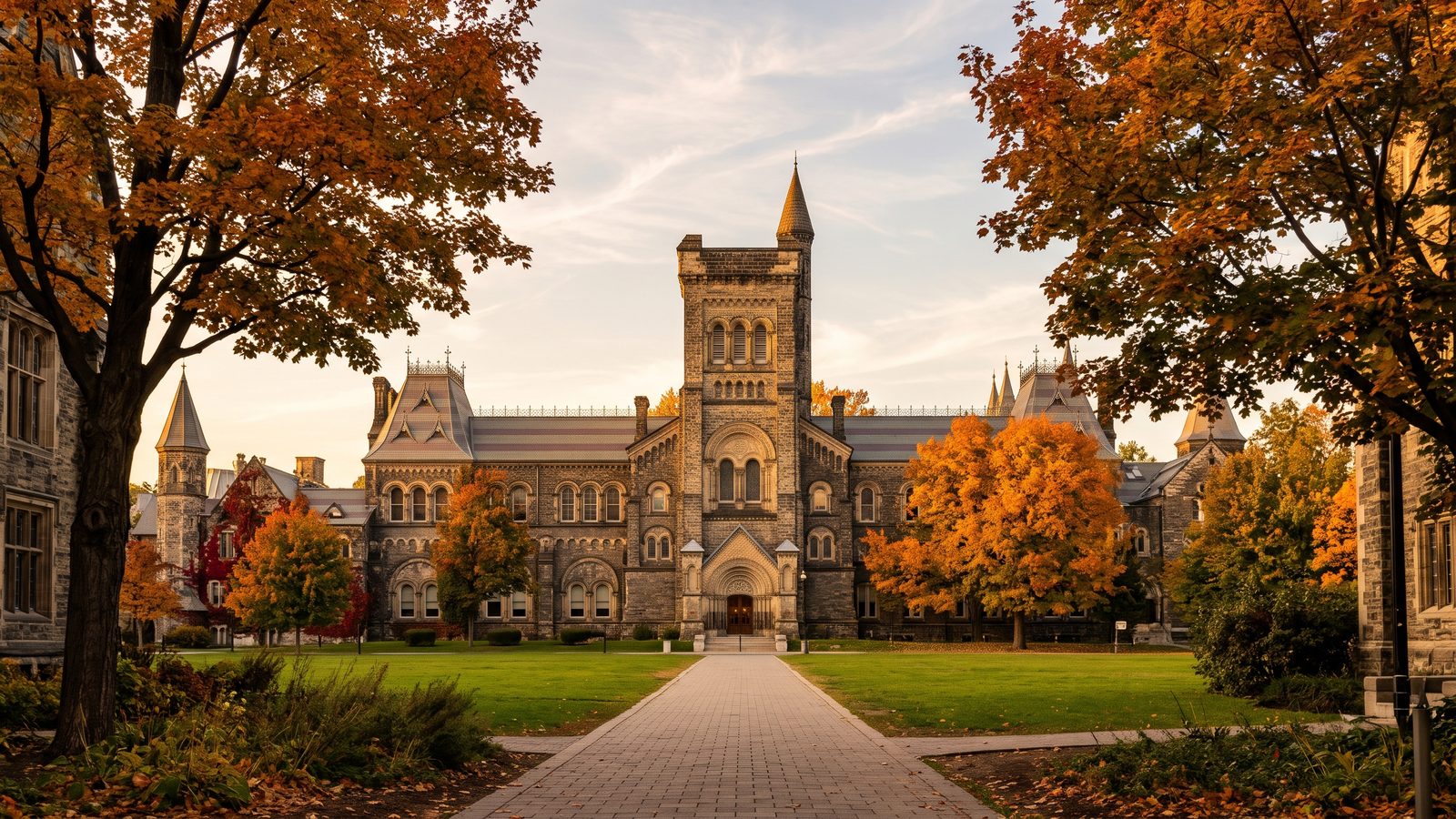
Step into Canada's premier academic landscape at the University of Toronto's historic St. George campus. Founded in 1827, this vibrant enclave seamlessly weaves grand Victorian architecture with cutting-edge modern research. As you explore leafy quadrangles, serene pathways, and majestic stone facades, you walk the very paths where world-changing discoveries like insulin took root and generations of scholars have left their indelible mark.
Experience a unique city within a city, where centuries-old traditions meet a global cultural hub. From the tranquil banks of Philosopher's Walk to the towering presence of historic libraries, this audio guide reveals the architectural marvels, rich history, and dynamic intellectual spirit defining Canada's celebrated educational cornerstone.
Listen to a sample
The opening of this tour, exactly as AllTours narrates it on site.
What you'll hear on this tour
Stop 1. Centuries of Architectural Styles in Stone
As you look around, you encounter an architectural narrative etched in stone and glass spanning centuries. You first notice the formidable Romanesque Revival style of University College, where heavy masonry, robust rounded arches, and rough-hewn sandstone form a fortress-like sanctuary adorned with intricate carvings. Shifting your gaze, you see the soaring Collegiate Gothic arches of Hart House and Trinity College, designed to echo Oxford and Cambridge with their ornate tracery and vertical elegance. Nearby, the domed Beaux-Arts classicism of Convocation Hall makes a grand civic statement. Finally, the massive Brutalist concrete form of Robarts Library anchors the modern skyline, showcasing an ever-evolving architectural mosaic.
Stop 2. Verdant Quads and Hidden Trails
You enter a verdant oasis carved directly into Toronto's urban fabric. Here, stone gargoyles on University College silently observe passing scholars, while the Collegiate Gothic lines of Hart House enclose a bustling student union complete with its own theatre and swimming pool. You can wander through quiet quadrangles, such as the peaceful courtyard hidden behind Trinity College, where centuries of academic discourse echo across the manicured lawns. As you follow Philosopher's Walk—a winding path tracing a buried stream—you find a shaded natural retreat linking major academic halls. Every sun-dappled bench and historic archway along this lush campus landscape holds decades of student stories and groundbreaking research.
Stop 3. From Anglican Roots to Secular Haven
You stand on ground that began its educational journey in 1827 as King's College under a royal charter with Anglican ties. That initial vision shifted dramatically in 1849 when pivotal legislation created the secular University of Toronto, democratizing higher education for all. The construction of University College, completed in 1859, physically embodied this new independent spirit through its striking Romanesque Revival arches and intricate stonework. Even after a devastating fire swept through the building in 1890, meticulous rebuilding proved the institution's enduring resilience. This rich history also established the federated college system you see today, allowing distinct, self-governing colleges to thrive together under one shared academic banner.
Stop 4. A Legacy of Innovation and Inquiry
You are standing at the heart of an institution renowned for research and intellectual pioneering. Here, education transformed from traditional instruction into an active pursuit of discovery. This collaborative environment fostered world-altering milestones, most famously the discovery of insulin that revolutionized medical treatment globally. Today, you see this legacy continue as students conduct advanced artificial intelligence research inside the Bahen Centre or study rare historic texts within Robarts Library. The university's signature collegiate system ensures a personalized educational experience, fostering tight-knit communities where spirited debates and interdisciplinary inquiry thrive. Within these historic halls, critical thinking flourishes to shape future leaders across every field of thought.
Stop 5. A Vibrant Global Crossroads
You can instantly feel the dynamic cultural pulse that animates every corner of this historic campus. Beyond lecture halls, hundreds of student clubs dedicated to global affairs, performing arts, and civic debate create a rich community tapestry. You pass the historic Hart House Theatre, a century-old creative hub that has nurtured generations of Canadian artistic talent. Storied collegiate traditions, such as formal High Table dinners at Trinity College, bring a unique blend of heritage and camaraderie to student life. Reflecting Toronto's international identity, the campus hums with diverse languages, global culinary flavors, and vibrant annual celebrations, creating an intellectually charged global crossroads where open discussion thrives daily.
Stop 6. Footsteps Along Historic Pathways
You walk along central paved avenues that originated as organic desire paths, carved into the earth by generations of students rushing between lectures. Over the decades, these informal trails evolved into formal arteries shaded by mature oak and maple trees. Beneath your feet, smooth flagstones bear silent witness to the passage of Nobel laureates, world leaders, and first-year scholars. Subtle variations in the paving stones reveal distinct eras of campus growth and historic expansion. Designed as a contemplative sanctuary between the bustling surrounding city and quiet study halls, these tree-lined walkways remain vibrant corridors where serendipitous encounters, casual debates, and major intellectual breakthroughs naturally unfold.
Planning your visit
- Best time to go
- Spring through autumn in the afternoon, when leafy trees frame the stone quads and natural light illuminates the facades.
- Approximate duration
- About 1 to 1.5 hours
- Where to start
- Outside the main entrance of University College near King's College Circle.
Access and conditions change seasonally — check the official site before you go.
Frequently asked questions
Is University of Toronto St. George Campus worth visiting?
Yes, the St. George campus is highly worth visiting for its striking blend of Romanesque Revival, Collegiate Gothic, and Brutalist architecture, lush green spaces like Philosopher's Walk, and deep historical significance.
How long do you need at University of Toronto St. George Campus?
Most visitors spend between 1 and 2 hours walking the main grounds, exploring quadrangles like Trinity College, and viewing historic landmarks like University College and Hart House.
When was the University of Toronto founded and how did it evolve?
The university was originally founded in 1827 as King's College under an Anglican charter. In 1849, it became the secular University of Toronto, establishing a unique federated college system that continues today.
Keep exploring
Header image is an AI-generated illustration of University of Toronto St. George Campus. AllTours.ai is an AI audio tour guide — point your camera at any landmark and hear its story.