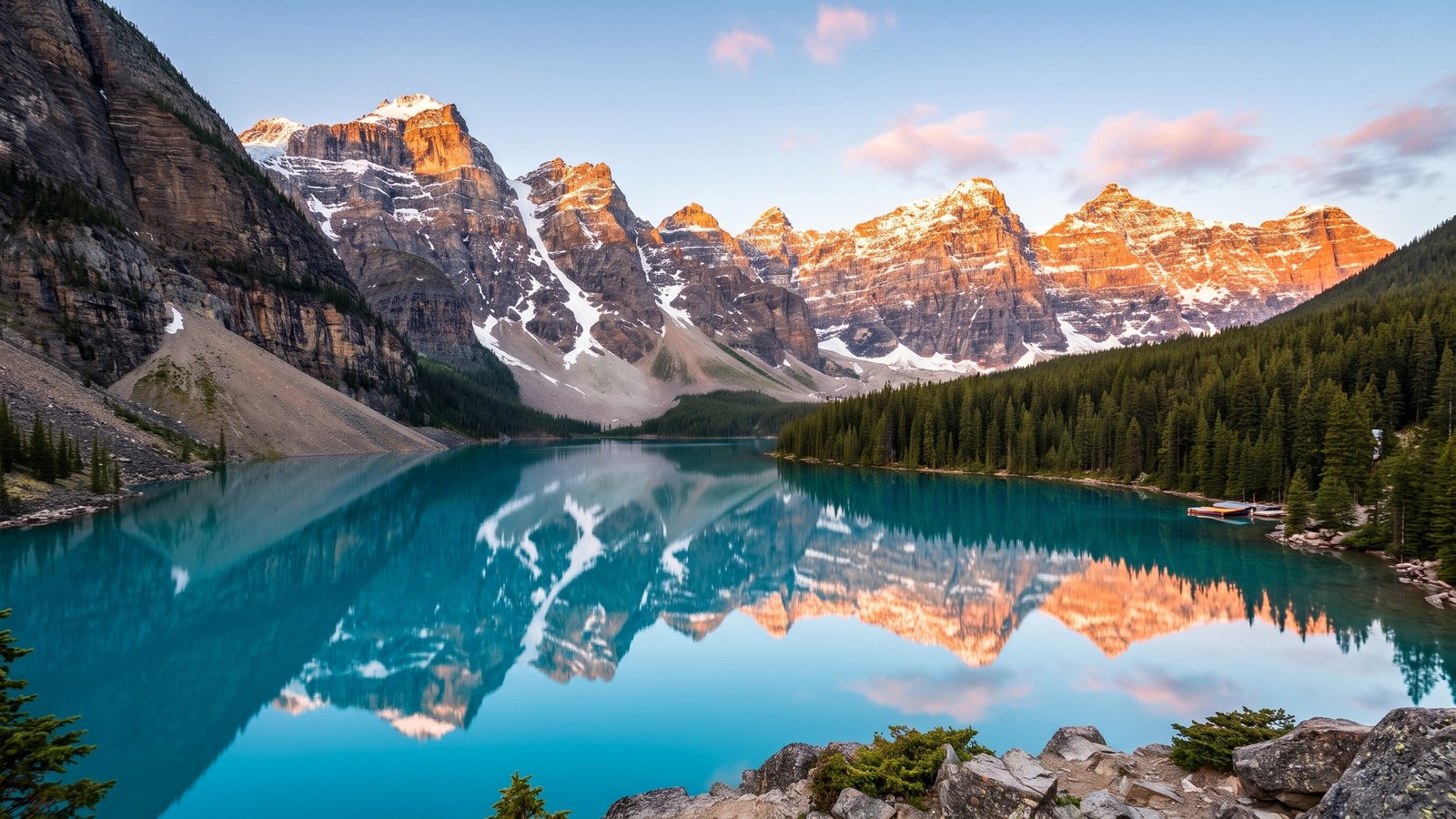
Welcome to the iconic Valley of the Ten Peaks in Banff National Park, Alberta. Towering over 3,000 meters above sea level, these ten colossal rock formations encircle the famous turquoise waters of Moraine Lake. Carved by ancient glaciers and steeped in mountain heritage, this breathtaking U-shaped valley offers visitors an immersive journey through sheer limestone cliffs, alpine forests, and pristine glacial landscapes that once adorned the Canadian twenty-dollar bill.
This audio tour guides you through the valley's rich indigenous heritage, daring mountaineering history, fascinating geological forces, and unmissable scenic viewpoints. Whether you are walking along the lakeshore, photographing alpenglow, or hiking alpine pass switchbacks, discover the wild heart of the Canadian Rockies at your own pace.
Listen to a sample
The opening of this tour, exactly as AllTours narrates it on site.
What you'll hear on this tour
Stop 1. Grand Spectacle of the Ten Peaks
You stand before a grand natural spectacle where ten prominent peaks pierce the sky, each soaring over 3,000 meters high. As you gaze across the U-shaped valley floor shaped by ancient glaciers, you trace a pristine alpine landscape first named by explorer Samuel Allen in 1894. Below these towering monuments, the vibrant turquoise waters of Moraine Lake catch stunning reflections of giants like Mount Fay. This iconic vista famously adorned Canada’s twenty-dollar bill in 1969. Take a moment to breathe in the crisp air as you explore trails beneath these sheer rock walls, preparing to experience the unforgettable power of an untouched mountain wilderness.
Stop 2. Indigenous Footsteps and Audacious Mountaineers
You walk on ground deeply connected to the Stoney Nakoda people, who traversed this valley long before European cartographers arrived. Their oral traditions recall sacred spirits inhabiting these towering peaks, which served as essential hunting grounds, trade routes, and places of refuge. As decades pass into the early 20th century, you trace the footsteps of courageous explorers like Samuel Wilcox and Conrad Kain. Driven by the thrill of alpine exploration, they braved harrowing conditions and primitive equipment to complete historic first ascents of giants such as Deltaform Mountain and Mount Tuzo. You feel their enduring legacy echoing across this rugged frontier with every step you take.
Stop 3. Ancient Seabeds and Glacial Sculptors
Look closely at the sheer rock walls around you. You are viewing layers of limestone and shale deposited over 500 million years ago when an ancient sea covered this land. Giant compressional forces during the Laramide Orogeny thrust these massive slabs upward, leaving distinct visible bands on peaks like Mount Deltaform. After this colossal mountain building, massive glaciers carved dramatic cirques and sharpened ridges into knife-edge arêtes connecting Mount Quadra and Mount Bident. The Rockpile beneath your feet is actually a terminal moraine left by retreating ice. That striking turquoise water gets its vivid color from fine rock flour suspended in Moraine Lake, scattering sunlight across the surface.
Stop 4. Sculpted Light Over an Amphitheater of Titans
As you look out across this sweeping amphitheater, shifting sunlight continually sculpts each mountain face. At dawn, eastern giants like Mount Little and Mount Bowlen catch the golden morning light, painting their cirques with a soft glow while deep shadows pool below. As the sun rises higher, crisp details reveal ancient geological folds along Mount Tuzo and Deltaform Mountain. Stand atop the Rockpile Trail to command a panoramic vista where dark subalpine forests contrast sharply against high, jagged cornices. Every step along the trail and every passing cloud redefines this iconic scene, offering endless opportunities to pause, contemplate, and absorb the wild majesty surrounding you.
Stop 5. Capturing the Magical Alpenglow and Turquoise Waters
You hold your camera ready as pre-dawn light turns Mount Little and Mount Bowlen into a glowing canopy of red alpenglow. To capture the entire Wenkchemna massif reflected in Moraine Lake, you wait for those rare, perfectly calm morning moments before the wind arrives. You can use a polarizing filter to intensify the lake's signature turquoise hue and cut surface glare. Instead of staying at popular vantage points, venture along the shoreline to frame shots with ancient subalpine firs or glacial rocks. If you visit during autumn, glowing golden larches offer brilliant color, while dark night skies reveal the Milky Way arching over dramatic mountain silhouettes.
Stop 6. Trails to Larch Valley and Alpine Passes
Feel the solid ground beneath your boots as you hike into the heart of the Rockies. Climb the switchbacks of the Larch Valley Trail, gaining over 500 meters to reach a golden canopy of larch needles illuminated by autumn light. Beyond the trees, the immense Wenkchemna Peaks tower dramatically above you. If you push further up the steep trail to Sentinel Pass, you look down into Paradise Valley, capturing the bold spirit of early mountain pioneers. For a gentler adventure, follow the path toward Consolation Lakes through ancient boulder fields to quiet tarns framed by giant rock walls, rewarding your efforts with unforgettable alpine views.
Planning your visit
- Best time to go
- Early morning at sunrise for calm water reflections, alpenglow photography, and smaller crowds, particularly from late June through October.
- Approximate duration
- about 2 to 4 hours
- Where to start
- Moraine Lake shoreline parking area and the start of the Rockpile Trail.
Access and conditions change seasonally — check the official site before you go.
Frequently asked questions
Is Valley of the Ten Peaks worth visiting?
Yes, the Valley of the Ten Peaks is one of Canada's most celebrated landscapes. Featuring ten soaring 3,000-meter peaks encircling the vivid turquoise Moraine Lake, it offers world-class photography, alpine hiking, and historic views once featured on the Canadian twenty-dollar bill.
How long do you need at Valley of the Ten Peaks?
Most visitors spend 2 to 4 hours taking in the views from the Rockpile Trail and walking along the Moraine Lake shoreline. Hikers tackling longer trails like Larch Valley or Sentinel Pass should plan for a half-day to full-day excursion.
Who first named the Valley of the Ten Peaks?
Explorer Samuel Allen first named the Valley of the Ten Peaks in 1894 during his explorations of the area, though the Stoney Nakoda people had lived in and named the surrounding landscapes for centuries prior.
Keep exploring
Header image is an AI-generated illustration of Valley of the Ten Peaks. AllTours.ai is an AI audio tour guide — point your camera at any landmark and hear its story.