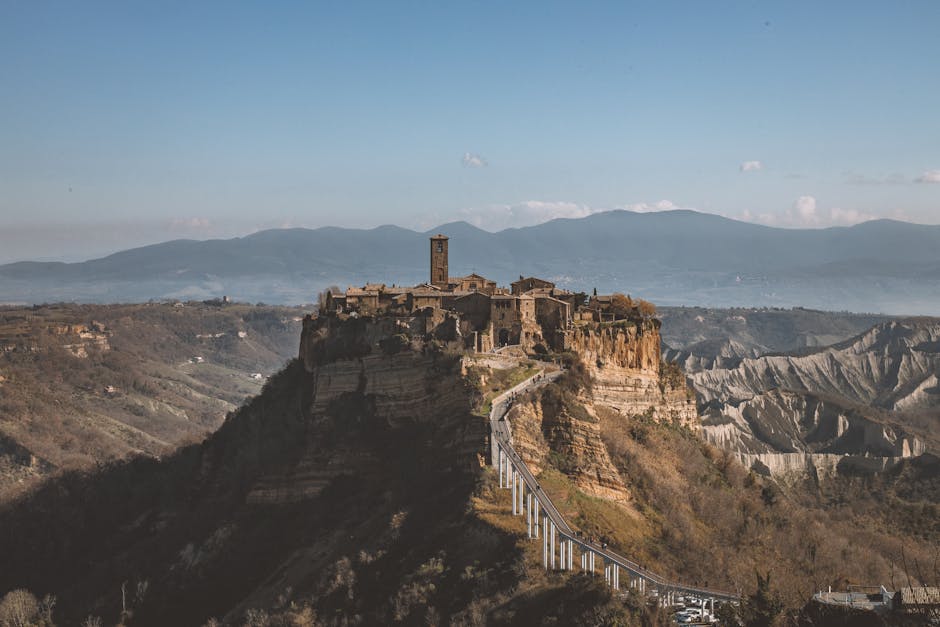
Welcome to Civita di Bagnoregio, a breathtaking testament to time and nature's relentless power. Perched atop a fragile volcanic tufa plateau, this ancient Etruscan town has been slowly shrinking for millennia, earning its poignant nickname, "il paese che muore" – the town that is dying.
Our audio tour invites you to traverse the iconic footbridge and explore its narrow alleys, revealing stories etched into every stone. From its enduring Etruscan roots to its modern-day struggle for survival, discover the resilience and serene beauty of a place quietly returning to the landscape.
What you'll hear on this tour
Stop 1. The Sole Gateway
As you begin your ascent across the long, narrow footbridge, take a moment to absorb the dramatic isolation of Civita di Bagnoregio. This is the only modern access to the town, a striking visual of its precarious existence. Imagine the generations who have crossed this chasm, once by more treacherous paths, now by this concrete link. The view back towards Bagnoregio and forward to Civita’s ancient walls encapsulates the profound sense of transition and the town’s enduring vulnerability, making the journey itself a significant part of the experience.
Stop 2. Porta Santa Maria
Stepping through Porta Santa Maria, you pass beneath an archway carved directly into the tufa rock, guarded by two ancient stone lions. This gate is Civita's primary entrance, once part of a larger defensive structure. The lions are said to represent the strength and vigilance of the town's inhabitants, even as the land beneath them slowly erodes. Feel the coolness of the rock and observe the worn stones, silent witnesses to centuries of arrivals and departures, pilgrims, merchants, and the few residents who call this remarkable place home.
Stop 3. Piazza San Donato
At the heart of Civita lies Piazza San Donato, a charming square dominated by the Church of San Donato. This square has served as the social and civic center for millennia, first as an Etruscan forum, then a Roman one. The church itself, built over a Roman temple, boasts a beautiful Romanesque facade and houses a venerated wooden crucifix. Stand here and imagine the vibrant life that once filled this space – markets, festivals, and daily gatherings – a stark contrast to the quiet solitude often found here today, reflecting the town's shrinking population.
Stop 4. Geologic & Cave Dwellings
Explore the fringes of the plateau, where ancient Etruscan tombs and medieval cellars are carved directly into the soft tufa rock. Some of these caves are now part of the Geological and Landslide Museum, offering insight into the very forces that shape Civita's destiny. Legend says many of these underground chambers were once used as shelters during sieges or as storage for olive oil and wine. Witness firsthand how humans have adapted to and utilized this unique geological landscape, creating homes and livelihoods within the earth itself.
Stop 5. The Belvedere Outlook
Make your way to one of Civita's outer edges, particularly the Belvedere, for a breathtaking panorama of the surrounding Calanchi valley. From here, you can truly appreciate the dramatic erosion that defines this region. The "badlands" below are a stark reminder of the tufa's fragility, sculpted by wind and rain over millennia. It’s a place for quiet contemplation, offering a profound sense of the town's isolation and its fight against nature's persistent reclaim. This view perfectly encapsulates why Civita is often called "the dying town."
Planning your visit
- Best time to go
- Early morning or late afternoon, especially during spring or fall.
- Approximate duration
- about 2-3 hours, including the walk across the bridge.
- Where to start
- At the beginning of the pedestrian footbridge leading to Civita di Bagnoregio, accessible from the parking areas in Bagnoregio.
Access and conditions change seasonally — check the official site before you go.
Frequently asked questions
Is there an entrance fee for Civita di Bagnoregio?
Yes, there is typically a small fee to cross the footbridge into Civita di Bagnoregio. This contribution helps fund the preservation and maintenance of the town, which is constantly battling erosion. Please check official local sources for current pricing.
How difficult is the walk to Civita di Bagnoregio?
The walk across the footbridge is a significant uphill climb, especially on the Civita side. It's paved but steep in places, requiring a moderate level of fitness. Comfortable walking shoes are highly recommended for the journey and exploring the town's cobblestone streets.
Are there places to eat or stay in Civita di Bagnoregio?
Despite its small size, Civita di Bagnoregio does have a few charming restaurants and a limited number of bed and breakfasts. These establishments offer local cuisine and a unique opportunity to experience the town's quiet atmosphere. It's advisable to make reservations, especially during peak season.
Keep exploring
Photography via Pexels. AllTours.ai is an AI audio tour guide — point your camera at any landmark and hear its story.