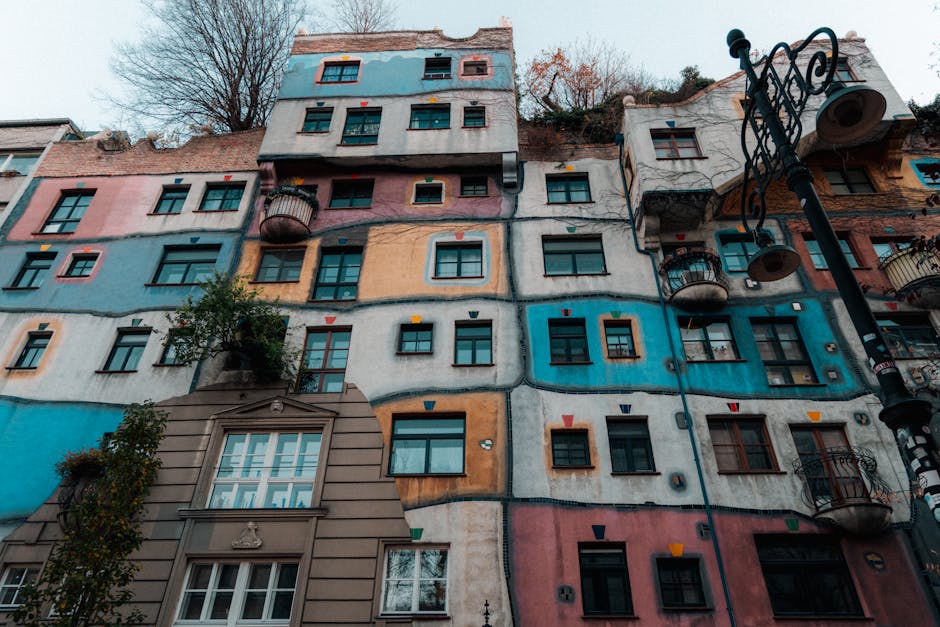
Welcome to the Hundertwasserhaus, a truly extraordinary architectural masterpiece in Vienna that defies convention and delights the senses. This isn't just a building; it's a living, breathing work of art, designed by the visionary Friedensreich Hundertwasser to challenge the rigid norms of urban design. Prepare to step into a world where every line is curved, every window unique, and nature intertwines with human habitation.
Our audio tour invites you to explore the vibrant facades, the unexpected green spaces, and the fascinating stories behind this iconic structure. Discover how Hundertwasser's philosophy of harmony with nature and individual expression shaped every detail, turning a residential building into a joyful protest against the mundane. Get ready to experience Vienna's most colorful rebellion.
What you'll hear on this tour
Stop 1. The Wavy Facade
As you stand before the Hundertwasserhaus, let your eyes wander across its vibrant, undulating facade. Notice how no two windows are alike, and not a single straight line can be found – a deliberate rebellion against what Friedensreich Hundertwasser called "godless and immoral" architecture. The building is a tapestry of bold colors, ceramic mosaics, and plaster textures, making each section a unique canvas. This radical design was meant to liberate inhabitants from the monotony of conventional urban living, turning their home into a joyful, ever-evolving work of art. It’s a powerful visual statement against conformity.
Stop 2. The Tree Tenants
Look closely at the balconies and rooftops, and you’ll see trees and shrubs flourishing directly from the building itself. Hundertwasser championed the concept of "tree tenants," believing that humans have a duty to share their living space with nature. These plants aren't just decorative; they are integral to the building’s philosophy, acting as natural air filters and contributing to a healthier urban environment. Each tree is a living testament to his vision of ecological harmony, creating a micro-forest that softens the urban landscape and constantly changes with the seasons, making the building feel alive.
Stop 3. Mosaic Pathways & Details
Even the ground beneath your feet tells a story here. Hundertwasser extended his artistic vision to the very pathways and public areas around the building, creating irregular, mosaic-like cobblestones and tiled surfaces. These uneven paths, deliberately designed to mimic natural terrains, encourage a different way of walking and experiencing the space – a departure from the monotonous grid of city streets. Look for the intricate ceramic details, colorful columns, and whimsical sculptures that pop up unexpectedly, each element contributing to the overall sense of organic artistry and playful rebellion that defines this unique landmark.
Stop 4. Hundertwasser Village
Just across the street, you’ll discover the Hundertwasser Village, a commercial complex that extends the artist's unique aesthetic into a public shopping and dining area. Designed by Hundertwasser himself, this village mirrors the residential building's vibrant colors, irregular shapes, and natural elements. Wander through its quirky shops and cafes, and notice the same characteristic lack of straight lines, the unexpected greenery, and the playful use of mosaics. It’s a fantastic opportunity to immerse yourself further in his distinctive world, offering a tangible experience of his artistic principles beyond the residential facade.
Stop 5. Kunst Haus Wien Exterior
A short walk from the Hundertwasserhaus stands the Kunst Haus Wien, a museum dedicated to Friedensreich Hundertwasser's work, housed in another building he designed. While the Hundertwasserhaus is a residential complex, the Kunst Haus Wien is a public space, yet it shares the same unmistakable architectural language. Observe its uneven floors, the vibrant, mosaic-covered facade, and the integration of trees and plants. The museum's exterior serves as a perfect complement, showcasing how his revolutionary ideas translated into a different functional building, providing a broader understanding of his impact as an artist and architect.
Planning your visit
- Best time to go
- Morning or late afternoon, especially in spring or autumn, to enjoy softer light and comfortable temperatures.
- Approximate duration
- about 45-60 minutes
- Where to start
- Begin your tour directly in front of the Hundertwasserhaus at Kegelgasse 36-38, easily recognizable by its colorful, wavy facade.
Access and conditions change seasonally — check the official site before you go.
Frequently asked questions
Can I go inside the Hundertwasserhaus?
The Hundertwasserhaus is a private residential building, so public access to the apartments is not permitted. However, you can freely explore the exterior and the immediate surroundings to admire its unique architecture. For an indoor experience of Hundertwasser's work, visit the nearby Kunst Haus Wien.
Is there anything else by Hundertwasser nearby?
Yes, absolutely! Directly across the street is the Hundertwasser Village, a commercial area designed in his distinctive style, featuring shops and cafes. A short walk away, you'll also find the Kunst Haus Wien, a museum dedicated to his art and architecture, housed in another building he designed.
What's the best way to get to Hundertwasserhaus?
The Hundertwasserhaus is well-connected by public transport in Vienna. You can take tram line 1 to the Radetzkyplatz stop or tram line O to the Marxergasse stop, both just a short walk away. Several bus lines also serve the area, making it easily accessible from various parts of the city.
Keep exploring
Photography via Pexels. AllTours.ai is an AI audio tour guide — point your camera at any landmark and hear its story.