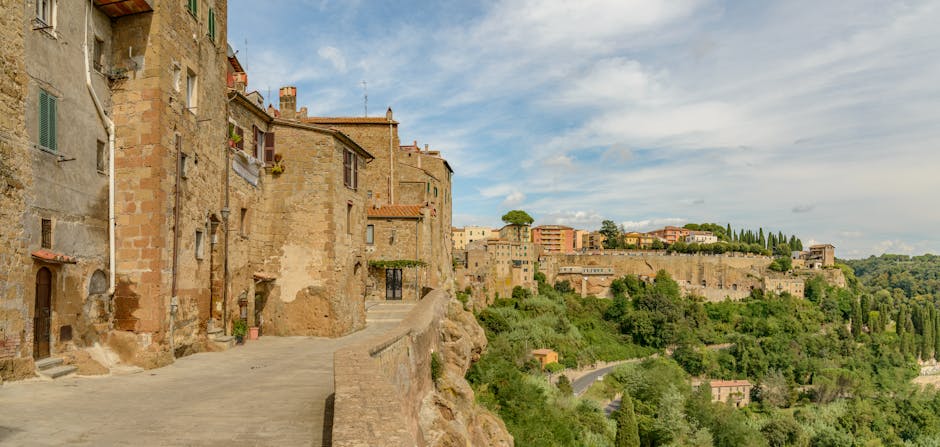
Welcome to Pitigliano, a village unlike any other, where history is literally carved into the landscape. Perched dramatically atop a volcanic tufa cliff, its buildings seem to emerge organically from the golden-brown rock, creating a breathtaking silhouette against the Tuscan sky. This self-guided tour invites you to step back in time and uncover the layers of civilizations that have shaped this extraordinary place.
From the mysterious subterranean world of the Etruscans to the enduring legacy of its Jewish community, Pitigliano tells a story of resilience, coexistence, and architectural marvel. As you wander its ancient alleyways and peer into its hidden corners, AllTours.ai will be your companion, revealing the secrets and stories of this 'Little Jerusalem' in the heart of Maremma.
What you'll hear on this tour
Stop 1. Palazzo Orsini
Begin your journey at the impressive Palazzo Orsini, a fortress that dominates the town's entrance. Originally a medieval castle belonging to the Aldobrandeschi family, it was later transformed into a magnificent ducal palace by the Orsini counts. Its robust walls and elegant Renaissance courtyard speak of centuries of power and artistic patronage. Imagine the noble families who once walked these halls, overseeing the life of the village below and defending their dominion against rival states. Today, the palace houses a museum, preserving artifacts that tell the story of Pitigliano's aristocratic past.
Stop 2. The Jewish Ghetto and Synagogue
Step into Pitigliano's poignant Jewish Ghetto, a testament to centuries of coexistence and the reason for its nickname, 'Little Jerusalem.' This historic quarter, with its narrow streets and ancient buildings, once thrived as a vibrant community. The Synagogue, rebuilt after wartime damage, stands as a symbol of resilience, offering a glimpse into Jewish life and traditions. Descend into the labyrinthine cellars beneath, where you can explore the ritual bath (mikvah), the kosher butcher, and the ancient bakery, all carved directly into the tufa rock, illustrating the community's deep roots here.
Stop 3. Vie Cave del Gradone
Venture just outside the main village to discover the mysterious Vie Cave – ancient Etruscan sunken roads carved deep into the volcanic tufa. The Vie Cave del Gradone is one of the most accessible and atmospheric. These narrow, towering passages, often dozens of feet deep, were chiseled by hand thousands of years ago. Their exact purpose remains a subject of debate: were they defensive routes, sacred paths, or simply practical roadways connecting settlements and necropolises? Walking through these cool, moss-covered canyons is an otherworldly experience, connecting you directly to Pitigliano's deep, prehistoric past.
Stop 4. Cathedral of Saints Peter and Paul
The Duomo, or Cathedral of Saints Peter and Paul, stands as a central pillar of Pitigliano's spiritual life. While its origins are medieval, the current facade dates largely from the 18th century, showcasing Baroque elements. Inside, the cathedral is home to several notable artworks, including a stunning canvas depicting the 'Madonna of the Rosary' by a student of Guido Reni. Its bell tower, originally a defensive watchtower, offers a striking contrast to the church's newer facade, embodying the town's continuous evolution from a fortified stronghold to a place of worship and community.
Stop 5. Medici Aqueduct
Admire the impressive Medici Aqueduct, a monumental engineering feat that brought vital water to Pitigliano. Begun in the 16th century by the Orsini family and completed by the Medici Grand Dukes, its grand arches span the valley, a testament to Renaissance ingenuity. This aqueduct was crucial for the town's growth and survival, ensuring a consistent water supply even during sieges. Standing beneath its majestic arches, you can appreciate not only its functional beauty but also the immense effort and vision required to construct such a vital infrastructure in a challenging landscape.
Planning your visit
- Best time to go
- Spring or early autumn offer pleasant weather. Mornings are ideal to avoid crowds and enjoy the soft light on the tufa.
- Approximate duration
- About 2 to 3 hours, allowing time for exploration and photos.
- Where to start
- Begin your tour at Piazza della Repubblica, easily recognized by the large fountain and the imposing Palazzo Orsini.
Access and conditions change seasonally — check the official site before you go.
Frequently asked questions
Why is Pitigliano called 'Little Jerusalem'?
Pitigliano earned its nickname due to the significant and historically well-integrated Jewish community that flourished here for centuries. The town provided refuge and allowed Jewish residents to establish a synagogue, schools, and essential services within a dedicated quarter, fostering a unique cultural blend.
What are the Vie Cave?
The Vie Cave are ancient, sunken roads carved deep into the volcanic tufa rock by the Etruscans thousands of years ago. These mysterious pathways served various purposes, from defensive routes and sacred processions to connecting settlements and necropolises, offering a unique glimpse into Etruscan engineering.
Is Pitigliano difficult to walk around?
The historic center of Pitigliano features narrow, cobbled streets and some steep inclines, typical of medieval hill towns. While generally manageable, comfortable walking shoes are highly recommended to fully enjoy exploring its charming alleys and hidden corners.
Keep exploring
Photography via Pexels. AllTours.ai is an AI audio tour guide — point your camera at any landmark and hear its story.