Welcome to the Roman Agora, a fascinating archaeological site that tells the story of Athens under Roman rule. While often overshadowed by its older, grander neighbor, the Ancient Agora, this area served as the city's bustling commercial and administrative heart during a significant period of its history.
This self-guided audio tour invites you to step back in time and explore the remnants of a vibrant marketplace. From monumental gates to ingenious ancient technology, you'll uncover the daily lives of Romans and Athenians, culminating in a close look at one of antiquity's most remarkable structures, the Tower of the Winds.
What you'll hear on this tour
Stop 1. The Tower of the Winds
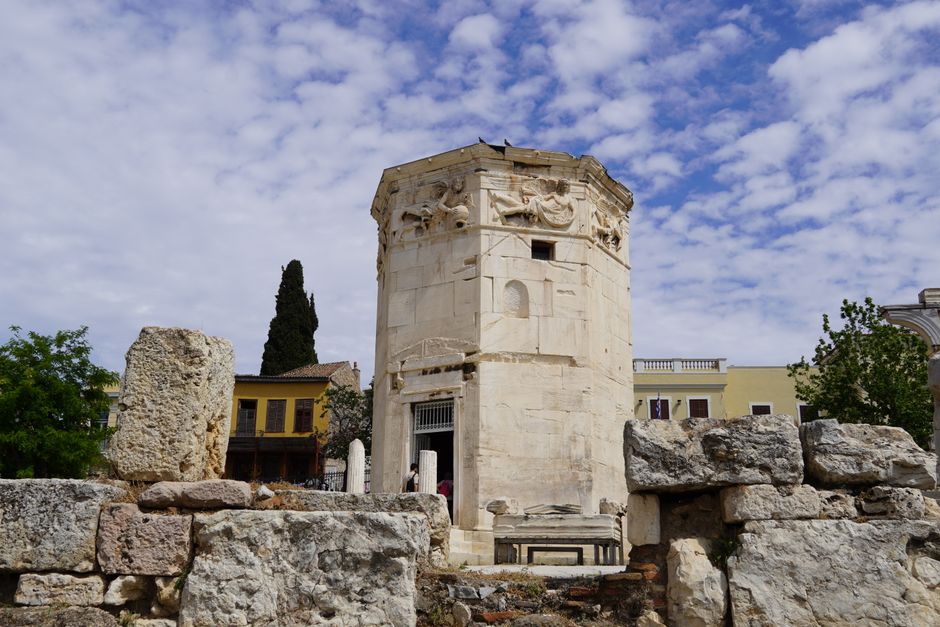
Standing proudly in the Roman Agora is the octagonal Tower of the Winds, a marvel of ancient engineering. Built in the 1st century BC by astronomer Andronicus of Cyrrhus, this structure served as the world's first meteorological station and public clock. Its exterior features sundials and relief carvings of the eight wind deities, each pointing to a specific direction. Inside, a sophisticated water clock mechanism ensured accurate timekeeping, making it an indispensable public utility for the citizens of ancient Athens and a testament to their advanced understanding of science.
Stop 2. Gate of Athena Archegetis
As you approach the Roman Agora, you'll encounter the monumental Gate of Athena Archegetis, the main western entrance. This impressive Propylon, dating back to the 11th century AD, was dedicated to Athena, the patron goddess of Athens. Its sturdy Doric columns and imposing architecture reflect the grandeur of Roman influence in the city. Imagine emperors like Augustus or Hadrian passing through this very gate, entering a bustling marketplace filled with merchants, philosophers, and citizens going about their daily lives.
Stop 3. The Agora's Central Courtyard
Stand in the heart of what was once the Roman Agora's central courtyard. This open space was the vibrant hub of commercial activity, surrounded by stoas (covered walkways) that housed shops and administrative offices. Here, goods from across the Roman Empire would have been traded, legal disputes settled, and public announcements made. Picture the lively crowds, the sounds of bargaining, and the aromas of spices and local produce, bringing to life the daily rhythm of an ancient Roman city.
Stop 4. Fethiye Mosque
Adjacent to the Roman Agora, you'll notice the Fethiye Mosque, a striking Ottoman-era structure. While not Roman, its presence here highlights the continuous layering of history on this ancient site. Built in the 17th century on the ruins of an earlier Christian basilica, which itself was likely built over an ancient Roman building, the mosque stands as a testament to the diverse cultures that have shaped Athens over millennia. It reminds us that historical sites are not static, but evolving landscapes reflecting centuries of human presence.
Stop 5. The Public Latrines
Discover a less glamorous, but equally fascinating, aspect of Roman daily life: the public latrines. These communal toilets, dating from the 1st century AD, provide a rare glimpse into ancient Roman sanitation and social customs. Imagine citizens gathering here, not just for practical reasons, but also for social interaction and conversation. While rudimentary by modern standards, they represent a significant public amenity for their time, showcasing the Roman emphasis on communal facilities even for the most private needs.
Planning your visit
- Best time to go
- Early morning or late afternoon, especially during spring or fall, to avoid crowds and the summer heat.
- Approximate duration
- About 45-60 minutes, allowing time to appreciate the details.
- Where to start
- Begin at the Gate of Athena Archegetis on the western side of the site, easily recognizable by its impressive Doric columns.
Access and conditions change seasonally — check the official site before you go.
Frequently asked questions
Is there an entrance fee to visit the Roman Agora?
Admission policies vary, and sometimes joint tickets are available for multiple archaeological sites in Athens. It's always best to check the official site for the most current information regarding entry requirements and opening hours.
How does the Roman Agora differ from the Ancient Agora?
The Roman Agora was constructed later, primarily under Roman emperors like Augustus, to meet the city's expanding commercial needs. The Ancient Agora, by contrast, was the traditional political, social, and religious heart of classical Athens, predating Roman rule by centuries.
Keep exploring
Photography via Pexels. AllTours.ai is an AI audio tour guide — point your camera at any landmark and hear its story.